 |
Chapter 10 will follow the assets — not just the money
The central issue is that Worcester Warriors was not one company owning one stadium and running one rugby team. By the time the club collapsed, the rugby business, the property interests, the long leases, the car park, the Premiership Rugby P Share and the loans secured against assets sat within a complicated network of legal arrangements.
That distinction matters enormously.
A buyer could acquire the rugby club without automatically acquiring the freehold of Sixways. A property company could own land without operating the team. A creditor could have security over an asset without owning it outright. And an administrator or receiver could have authority over particular assets without taking control of everything associated with Worcester Warriors.
We will therefore follow each asset through its documented history, from the 2018 sale through the 2021 property restructuring, the September 2022 collapse, the administration and receivership, and the subsequent sales.
We will also separate the £9.8 million actually realised from the P Share from its earlier accounting value and from the much larger cost of acquiring a new P Share in the future. The evidence also reveals a detail we must not gloss over: the administrators’ own report says the 999-year lease was surrendered in August 2022 and a new 999-year lease, containing restrictions, was subsequently entered into for part of the land. They valued the leasehold premises in the company’s accounts at £15.19 million but described the realisable value as uncertain.
That is a material fact in the story, not a minor technicality. Balance Sheet +1 And we have a documented endpoint for the car-park security: Companies House records both Triangle Estate & Petroleum charges as satisfied on 17 September 2024.
The record also shows newer charges over freehold land, created on 30 December 2024 in favour of Sixways Stadium Limited and Worcester Sport Limited acting through the receivers.
Those entries deserve close attention because they show that the legal and financial arrangements continued to change after the original club sale. |
CHAPTER 10
THE ASSETS: SIXWAYS, THE LAND
THE £9.8 MILLION P SHARE
The rugby club could be bought. The stadium could be controlled. The land could sit in another company. And the most valuable rugby asset of all could be sold to pay a government debt. To understand what happened to Worcester Warriors, we must follow each of them separately.
The question at the heart of the story
When Worcester Warriors entered administration in September 2022, supporters quite reasonably assumed that the administrators would take control of the club, investigate its finances, sell what could be sold and settle the debts as far as the available money allowed.
That is broadly what an insolvency process is intended to achieve. But Worcester was not a straightforward case. By the time the administrators arrived, the stadium, the surrounding land, the rugby operation and the assets used to finance the business were spread across a network of companies, leases and security arrangements.
The distinction was not academic. It determined what the administrators could sell, what receivers could control, which creditors had security over particular assets and what a prospective buyer would actually acquire.
The administrators’ own report recorded that WRFC Trading Limited had leasehold premises with a book value of £15.188 million at 30 June 2022. Yet they described the estimated realisable value as uncertain. The same report recorded that the P Share and fixed-interest stocks had a combined book value of £13.865 million, but that their realisable value was also uncertain because of the rights attached to the shares and the government’s security. [1]
Those figures illustrate the problem. An asset can appear valuable in a company’s accounts without being freely available for sale, without belonging to the company that supporters assume owns it, and without generating enough cash to repay the creditors whose security is attached to it.
Our task is to follow the property and rugby assets through the transactions that took place between 2018 and the present structure. We must establish what was owned, what was leased, what was charged as security, what was sold and what remains uncertain. |
2018: Sixways changes hands
but the structure changes too
The property story takes us back to the takeover of September 2018.
At that time, the Sixways site was a major part of the attraction of Worcester Warriors. The stadium, training facilities, surrounding land and potential for commercial development gave the club a physical asset base extending beyond the rugby business itself. In 2017, a reported valuation placed approximately £17 million on the Sixways site and £9.7 million on the rugby club, producing a combined figure of £26.7 million. Those were reported valuations, not proof that the assets could necessarily be sold for those amounts.
On 28 September 2018, the day of the acquisition, MQ Property Co Limited acquired the freehold of the stadium and land for £6.25 million, according to The Guardian. MQ Property was associated with the incoming ownership network and was directed initially by Gerard McCrory. [2]
But the transaction did not end with MQ Property holding the freehold and the rugby club simply carrying on as before.
The freehold was followed by a complicated set of lease arrangements. A 999-year lease was transferred to Link Corporate Trustees, acting on behalf of Alpha Real Capital, while WRFC Trading received a 175-year lease. The effect was that the property ownership and the right to occupy and operate from the stadium were divided between different legal interests.
In practical terms, the company operating Worcester Warriors was not in the same position as a company holding an unencumbered freehold. WRFC Trading had a long lease, while the freehold and the very long leasehold interest sat elsewhere. The Guardian described the arrangements as an unusual, triangular form of sale and leaseback. The paper also reported that the 175-year lease was subsequently valued in WRFC Trading’s accounts at about £16.5 million, while the freehold was recorded at nil in MQ Property’s accounts because of the 999-year leasehold interest held by Link Corporate Trustees. [2]
That accounting treatment needs to be understood properly. A nil book value for the freehold did not mean that the land had no market value. It reflected the effect of the long lease arrangement on the value attributed to the freehold interest. Likewise, a £16.5 million valuation of a lease did not mean that WRFC Trading had £16.5 million in cash or could sell the property free of restrictions.
The question supporters should ask is not simply why the property was valued at one figure rather than another. It is why the structure was established, how it was financed, which company carried the obligations and what rights each party held.
The public reporting raised those questions, but the complete legal explanation cannot be inferred from the headline figures alone. The leases, conveyances, charges and relevant company accounts are the evidence needed to reconstruct the full arrangement. |
February 2021
Public money and the property settlement
The next major turning point came during the COVID pandemic, when Worcester Warriors received government-backed support under the Sport Winter Survival Package.
The club’s government loan ultimately reached £15.706 million in principal. At the date of administration, the administrators recorded a total claim of £16,134,720.40, including £428,720.40 in interest, before enforcement and other recoverable costs. The loan was secured by a fixed charge over the P Share and the company’s invested units in Premier Rugby Limited, together with a floating charge over the company’s other assets. [1]
The property arrangements were also changing during this period.
The Guardian reported that approximately £4.83 million of the government-backed funding was used in connection with the acquisition or restructuring of the 999-year leasehold interest, while approximately £4.4 million was used to release existing charges over the P Share. The paper’s investigation described a settlement that brought the stadium and surrounding land back under MQ Property’s ownership, rather than simply transferring the freehold to WRFC Trading. [2]
These figures are important, but they must not be presented as though we possess a complete, independently reconciled statement of every payment. The reported amounts describe the transactions as understood from the available records. The exact allocation and legal effect of every element of the restructuring require the underlying completion statements and legal documents.
The broader issue is nevertheless clear. Public support was intended to help the club survive the pandemic, but a significant part of the funding was associated with existing financial and property arrangements. The club was not simply handed a large, unrestricted sum that could all be spent on wages, suppliers and running costs.
The government’s position was strengthened by security over the P Share and other assets. The property arrangements, meanwhile, continued to evolve through separate companies and leases.
That brings us to the critical question:
when the club approached administration in 2022,
exactly which property rights did WRFC Trading still hold? |
August 2022
The 999-year lease changes again
The administrators’ Statement of Proposals provides an important answer
and raises further questions.
It records that WRFC Trading’s management accounts attributed a book value of £15,187,548.02 to its leasehold premises at 30 June 2022. But the administrators explained that the company had previously benefited from a 999-year lease over land surrounding the stadium. In August 2022, that lease was surrendered, and WRFC Trading subsequently entered into a new 999-year lease covering part of the same land, with a number of restrictions. The administrators therefore described the realisable value of the leasehold premises as uncertain. [1]
This was not a trivial change in paperwork. A 999-year lease can resemble a freehold in its practical duration, but it remains a lease with legally defined rights, obligations and restrictions. The exact land covered, rights of access, permitted use, rent provisions and any restrictions on dealings can materially affect its value.
The new lease also needs to be distinguished from the 175-year lease discussed earlier. We should not assume that the two leases covered identical land, conferred identical rights or were simply interchangeable. The administrators’ report makes clear that the leasehold arrangements had changed and that the new 999-year lease covered only part of the same land.
The company’s accounts could show a substantial book value, but the administrators could not confidently estimate what the interest would realise. This is a key example of why book value and sale value must never be treated as the same thing. |
The creation of Sixways Stadium Limited
The property picture became more complicated still in August 2022.
A separate company, Sixways Stadium Limited, had been incorporated on 15 June 2022. Companies House records Colin Goldring and Jason Whittingham as its directors at incorporation. [3]
The Guardian reported that on 4 August 2022 the stadium was transferred from MQ Property to Sixways Stadium Limited for no consideration. The paper reported a valuation of £14.65 million for the stadium and a new 999-year lease arrangement under which WRFC Trading’s use of the stadium was restricted to rugby playing and training. The lease also allocated hospitality, sponsorship, pouring-rights and marketing income to the property company, with market-rate rent provisions applying after five years. [2]
This arrangement matters because it separates the right to play rugby at Sixways from several of the commercial rights associated with the venue. The company operating the team could use the stadium for its defined purpose, but it did not necessarily control every revenue stream generated by the site.
It also helps explain why a buyer interested in rescuing Worcester Warriors insisted that the land and stadium arrangements had to be examined. On 27 September 2022, Jim O’Toole told the BBC that the ownership of the land was key to any deal. His concern was that the administrators needed to establish precisely what had happened to the assets and liabilities. [4]
The administrators’ subsequent report confirmed that they were examining property and land transactions, obtaining the relevant leases and conducting Land Registry searches. They were appointed as joint receivers of Sixways Stadium on 27 September and, on 5 October, as receivers over certain assets of Worcester Sport Limited, including the entire issued share capital of MQ Property. [1]
Those appointments were designed to improve the administrators’ ability to deal with the key assets and seek the best available return for creditors. They did not mean that every company or every property interest became part of WRFC Trading’s administration. Nor do the appointments alone prove that the administrators transferred every underlying freehold or leasehold interest into the operating company.
The legal interests still had to be traced individually. |
The £600,000 car-park loan: security, repayment and the charge
The car park became another important part of the property story during the final weeks before administration.
In August 2022, a £600,000 loan carrying 20% interest for three months was secured against part of the land associated with Worcester Warriors. The lender was Triangle Estate & Petroleum Limited. The transaction was reported by The Guardian, which also described the alternative offer of £780,000 interest-free that was conditional on a buyer being found and the charge being released. [2]
Companies House records two Triangle charges against MQ Property Co Limited, created on 15 August and 31 August 2022. Both were recorded as satisfied in full on 17 September 2024. [5]
The administrators’ November 2022 report adds an important detail: Jim O’Toole’s consortium had paid approximately £634,000 in full to settle amounts owed by MQ Property to Triangle Estate & Petroleum Limited. [1]
The documented chain is therefore:
-
A loan was secured against property associated with Sixways.
-
The registered borrower/charged company was MQ Property Co Limited.
-
The administrators recorded a subsequent payment of approximately £634,000 by the O’Toole consortium to settle the amount owed.
-
The two registered Triangle charges were later marked as satisfied.
This is a more complete trail than we have for some of the other loans. It establishes that the charge did not remain on the Companies House register as outstanding.
However, there are still limits to what we can conclude. The original £600,000 principal and the later £634,000 settlement are different amounts. Without the complete loan and settlement documents, we should not pretend to have reconciled every element of the difference. Nor does satisfaction of the charges establish, by itself, the full subsequent ownership history of the car park.
The significance is that a short-term loan taken out during the club’s final weeks became a charge over property that later had to be dealt with through the wider rescue and ownership process. |
The administrators take control — but not of everything
When the administrators were appointed in September 2022, they had to establish which assets belonged to WRFC Trading, which were held by other companies, and which were subject to security.
Their report recorded a fixed-charge asset category containing the P Share and fixed-interest stocks, with a combined book value of £13.865 million. It separately recorded the leasehold premises at £15.188 million. Other assets included goodwill, plant and machinery, IT equipment, stock, book debts, cash and a connected-party debtor balance. [1]
The administrators were not dealing with a single pool of unencumbered assets. The government had security over the P Share and other assets. The property was subject to complex lease arrangements. The stadium and MQ Property were dealt with through receivership appointments, while the rugby operation was administered through WRFC Trading.
That is why the phrase “the administrators took over Worcester Warriors” can be misleading if used without qualification. They were appointed to specific companies and assets under specific legal powers. Their role was to act in accordance with insolvency law and the interests of creditors, not to take unrestricted ownership of everything that had ever been associated with the club.
The administrators marketed the business and assets, received interest from 19 parties, and reported that 12 signed non-disclosure agreements to access the data room. Three offers were received. The consortium led by O’Toole was selected as the preferred bidder because its overall offer was judged to produce a better return for creditors than the alternatives, supported by valuations from Eddisons
An exclusivity fee of £500,000 was received and held by the administrators. [1]
This was not the same as the £600,000 Triangle loan, and neither amount should be confused with the £500,000 Duckworth-related loan discussed in the previous chapter.
The sale process would eventually produce a buyer for the rugby business and associated assets, but the property interests still required separate attention. |
2023
The £2.05 million Atlas acquisition
and what it did not buy
In May 2023, the sale of Worcester Warriors to the Atlas consortium, headed by Jim O’Toole and James Sandford, was completed. The BBC subsequently reported that Atlas paid £2.05 million for the former Premiership club and still had a further £1.18 million to pay by 9 October 2023. [6]
The crucial point is that the rugby club’s sale was not the same as the completion of the purchase of the stadium and surrounding land.
In August 2023, the BBC reported that Atlas had completed the club acquisition in May but had not completed the purchase of Sixways Stadium and surrounding land. Atlas had a licence to use Sixways as its trading premises while the property arrangements remained unresolved. [6]
This distinction should be kept firmly in mind.
The acquisition gave the new owners the rugby business and assets specified in the sale, including the club’s goodwill and brand. It did not automatically deliver the freehold of the stadium or every property interest held by the separate property companies.
The P Share was also not inherited as part of the new club’s operating assets. The administrators sold it back to Premiership Rugby, and the proceeds were used primarily to reduce the government loan.
By the end of 2023, therefore, the position was unusual.
Atlas had bought the rugby club, but the stadium and surrounding land were still subject to a separate ownership and financing story. The new owners had to operate within that reality while attempting to rebuild a viable rugby business. |
The P Share: £13.865 million on the books,
£9.8 million in the sale
The P Share was one of the most valuable assets in the administration, but it is important to distinguish its accounting value from the money actually received.
At 30 June 2022, WRFC Trading’s management accounts recorded £13.865 million for the P Share and other fixed-interest stocks together.
The administrators could not assume that the whole amount would be realised. The share was subject to the Premiership Rugby shareholders’ agreement and pre-emptive rights, including a call option that could be triggered in certain circumstances such as administration. [1]
The eventual outcome was a sale of Worcester’s P Share back to Premiership Rugby for £9.8 million. The BBC reported in August 2023 that the bulk of the proceeds went towards paying off part of the government-backed COVID loan. [6]
The P Share was therefore not an asset passed to Atlas for the new Worcester Warriors to use in the future. It was sold as part of the administration, and the cash raised was used primarily to reduce a secured debt.
This matters enormously for the club’s longer-term ambitions. A return to the Premiership is not simply a question of winning promotion on the pitch. The new club must meet the relevant league and RFU requirements, and a P Share is a separate financial and regulatory issue. The former P Share had been sold to repay creditors; it could not simply be assumed to remain available to a future Worcester Warriors team.
Supporters have discussed figures of £20 million for acquiring a new P Share. However, the evidence must be precise: a figure of £13.5 million was attributed to Chris Holland at a supporters’ meeting in January 2025, while the historical sale of Worcester’s P Share was reported at £9.8 million. Those figures relate to different circumstances and dates.
The £20 million figure should not be presented as a confirmed current purchase price without a current, authoritative source. [7]
The important fact is not whether one particular estimate is correct. It is that the club lost the P Share during the administration, and any future acquisition must be assessed under the rules and price arrangements applying at the time. |
2024
Atlas fails, Junction 6 steps in
The next major change came when Atlas itself entered administration in April 2024.
According to the subsequent statement published by Sixways Stadium, Loxwood Holdings — a group company associated with Wasps — had provided financial assistance to Atlas in May 2023 to help it complete the purchase of Worcester Warriors and support stadium operating costs. The statement said the support was intended to be temporary and was also connected with the possibility of Wasps using Sixways while pursuing its own longer-term plans.
Atlas was ultimately unable to meet its ongoing financial obligations. [8]
Quantuma’s joint administrators were appointed to Atlas on 24 April 2024 and completed a pre-pack sale of its business and assets to Junction 6 Limited shortly afterwards. The stated purpose was to preserve the operating business, protect more than 60 jobs and keep the stadium trading while supporting the return of professional rugby. [9]
This was another separate transaction. Atlas’s insolvency did not simply reverse the 2023 acquisition and return the club to the previous owners. Instead, its business and assets were sold through a new insolvency process to Junction 6.
In April 2024, the Sixways Stadium statement said that the new group had acquired Atlas’s business and assets, would continue to employ existing staff and would work towards restoring elite-level rugby. [8]
The property position also changed. Junction 6 Limited became the person with significant control of MQ Property Co Limited on 30 December 2024, replacing Militibus Quanco Limited. Companies House records Chris Holland’s appointment as a director of MQ Property on the same date. [5]
The official Warriors website subsequently stated that the takeover of Worcester Warriors by Junction 6 in 2024 had been pivotal in the recovery of stadium operations. Chris Holland said it had become necessary to take over the freehold interests of the stadium and the Warriors. [10]
The distinction between the legal record and the public statement remains important.
The official statement confirms the club’s account of the acquisition; Companies House confirms the change in control of MQ Property.
The full conveyance documents and title records are the best evidence for identifying each parcel of land and the precise legal interest transferred.
We should not claim that every title, lease or charge changed in exactly the same way unless the relevant documents establish it. |
What do the latest property records tell us?
The Companies House records show that the property structure continued to change after Junction 6’s arrival.
Two Triangle Estate & Petroleum charges against MQ Property were recorded as satisfied on 17 September 2024.
A new charge in favour of Loxwood Holdings was created on 6 September 2024 and was recorded as outstanding on the register.
Two further charges, created on 30 December 2024, were registered in favour of Sixways Stadium Limited and Worcester Sport Limited, acting by the receivers. Both were shown as outstanding in the Companies House record consulted for this chapter. [5]
These entries matter because they show that the property interests were still subject to formal security arrangements after the Atlas acquisition and during the transition to Junction 6.
But a charge is not the same as ownership. It is security granted in favour of a creditor or other entitled party. Its existence does not, by itself, prove that the charge-holder owns the property outright, that the loan has been called in, or that the charged asset has been repossessed.
The same caution applies to the status of Sixways Stadium Limited. Companies House records the company as being in “Receiver Action”. Its existence and status should not be confused with the status of WRFC Trading or Atlas, each of which went through its own insolvency process. [3]
The records therefore support a careful conclusion: the land, the stadium operation and the rugby business have passed through different corporate and insolvency arrangements. Junction 6’s acquisition and the change in control of MQ Property mark a major change in the ownership structure, but the precise status of every freehold, lease and security must be established from the underlying property documents. |
So who owns what?
The history can be summarised in a way that avoids confusing the legal entities.
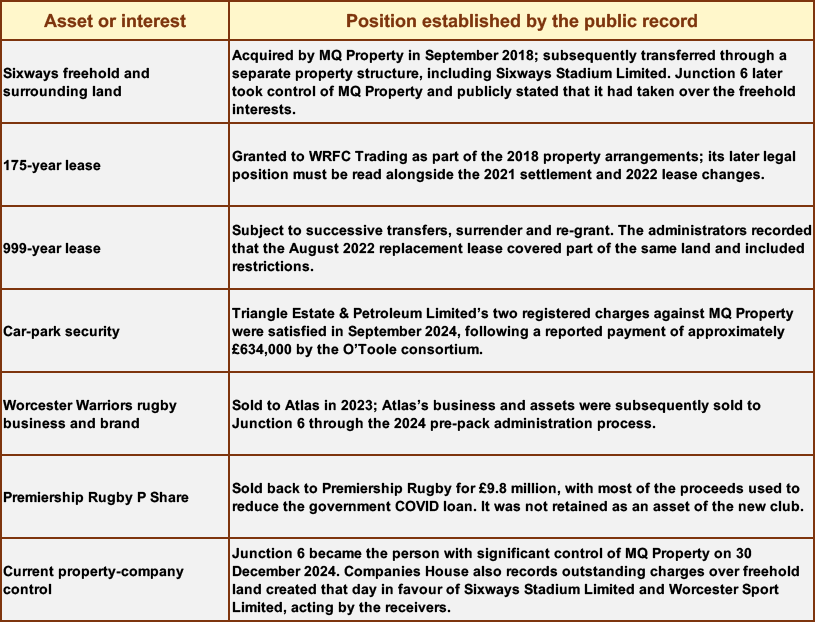
This is the picture supported by the records currently cited.
It is not a substitute for a full Land Registry title-by-title schedule.
To provide that, we need the title registers and filed conveyances for each relevant parcel, including the stadium, adjoining land, car park and access routes. Those documents will establish the registered proprietor, the nature of the estate, the charges and any restrictions that remain. |
What this means for Worcester Warriors
The property history explains why the rescue of the club could not be completed in a single transaction. The rugby business, the stadium freehold, the long leases, the car park and the P Share were not one indivisible asset. They were different legal interests, held or controlled through different companies and subject to different creditors and conditions.
The administrators’ role was to realise value for creditors within the powers available to them. The receivers’ role related to specific assets and security arrangements. The 2023 Atlas acquisition gave the rugby club a new owner, but did not complete the purchase of Sixways and its surrounding land. Atlas’s failure then led to another administration and a further sale to Junction 6.
The P Share was sold to repay a secured government loan. The car-park charges were later satisfied. Junction 6’s control of MQ Property and the public statement that it took over the freehold interests marked another important stage in bringing the stadium and rugby operation back under a common ownership structure.
But we must not confuse the recovery of the assets with the recovery of every debt.
The P Share proceeds reduced the government claim; they did not settle all the liabilities of WRFC Trading, WRFC Players or the other companies. Nor does a change in property ownership establish that the old owners’ creditor claims were accepted or paid.
Those questions remain part of the wider investigation. |
The conclusion: the assets survived, but the structure changed
The most important conclusion from this chapter is that the story of Sixways was not simply one of a stadium being sold and then bought back. It was a sequence of transactions involving a freehold, long leases, property companies, secured loans, receivership appointments and separate sales of the rugby business.
The original ownership arrangements were altered. The administrators and receivers had to work through those arrangements to identify and realise assets. Atlas bought the rugby business, but not the complete property package. When Atlas failed, Junction 6 acquired its business and assets and subsequently took control of the property company. The P Share, meanwhile, was sold back to Premiership Rugby for £9.8 million and the proceeds were used primarily to reduce the government loan.
For supporters, the central question — who owns what? — now has a much clearer answer at company level. Junction 6 is central to the present structure, with MQ Property under its control and the club’s official statements describing the freehold interests as having been brought together. But the exact legal position of every title, lease and charge must still be confirmed from the underlying records.
The assets are not the whole story. We must now examine the people and companies behind the transactions, the role of Atlas and Loxwood, the position of the former owners, and whether any claims or liabilities remain unresolved.
Chapter 11 will follow the end of the old structure — the companies, the insolvencies, the former owners’ claims and the questions that remain after the sale of the assets. |
Sources and evidence
[1] Begbies Traynor, WRFC Trading Limited — Joint Administrators’ Statement of Proposals, November 2022. This is the principal source for the administrators’ account of the leasehold premises, the P Share and fixed-interest stocks, security held by the government, the sale process, the 19 interested parties and the Triangle Estate & Petroleum settlement.
https://www.scribd.com/document/625817695/Joint-Administrators-Statement-of-Proposals-WRFC-Trading-Limited
[2] The Guardian, 5 October 2022, Worcester Warriors: the inside story of a rugby club’s collapse. The investigation describes the 2018 freehold transaction, the lease arrangements, the 2021 restructuring and the August 2022 transfer involving Sixways Stadium Limited.
https://www.theguardian.com/sport/2022/oct/05/worcester-warriors-the-inside-story-of-a-rugby-clubs-demise
[3] Companies House, Sixways Stadium Limited, company number 14173683.
https://find-and-update.company-information.service.gov.uk/company/14173683
[4] BBC Sport, 27 September 2022, Sixways land key to any deal, says takeover figurehead Jim O’Toole.
https://www.bbc.co.uk/sport/rugby-union/63045806
[5] Companies House, MQ Property Co Limited, company number 11472994 — filing history, persons with significant control and charges register.
https://find-and-update.company-information.service.gov.uk/company/11472994
https://find-and-update.company-information.service.gov.uk/company/11472994/charges
[6] BBC Sport, 7 August 2023, Worcester Warriors: Atlas paid £2m for ex-Premiership club, confirm administrators.
https://www.bbc.co.uk/sport/rugby-union/66430181
[7] The Forum, The P Share, discussing the £9.814 million sale of Worcester’s P Share and the figure attributed to Chris Holland at a January 2025 supporters’ meeting. The £13.5 million figure is reported as a statement at that meeting, not an independently verified current market price.
https://www.rugbynetwork.net/main/s130/st207438.htm
[8] Sixways Stadium, 25 April 2024, Bringing professional rugby back to Sixways with Junction 6 Limited.
https://www.sixwaysstadium.co.uk/news/bringing-professional-rugby-back-to-sixways-with-junction-6-limited/
[9] Quantuma, 25 April 2024, All jobs saved with pre-pack sale of Worcester Warriors Rugby Club.
https://www.quantuma.com/insights/all-jobs-saved-pre-pack-sale-worcester-warriors-rugby-club
[10] Worcester Warriors, 3 April 2025, Worcester Warriors return to professional rugby.
https://warriors.co.uk/news/worcester-warriors-return-to-professional-rugby/ |
Editorial standard
This chapter distinguishes registered ownership, company control, leases, security interests and public statements. A charge does not establish outright ownership; an accounting valuation is not necessarily a realisable sale price; and a company’s acquisition of a business does not automatically transfer every freehold or lease. Where the complete conveyance or title document has not been established, the chapter identifies the limit rather than claiming certainty. |
WHAT DO YOU THINK ABOUT THE ARTICLE
(Make your selection below) |
|
|
|
|
|
 |