 |
Chapter 14
Back Where We Want To Be
From the Ashes of Administration to Championship Glory
The 2025–26 season — a team reborn, a city reunited and a final that will live in Worcester Warriors history
The season nobody dared to dream of
A year earlier, Worcester Warriors had no professional playing squad, no coaching team and no medical department. The club that had once competed among English rugby's elite had disappeared from the professional game, leaving its supporters wondering whether the blue and gold would ever take the field again.
By the end of May 2026, Worcester Warriors were Championship winners.
It is difficult to imagine a more extraordinary turnaround.
The club's return to professional rugby had already been celebrated in Chapter 13. The painstaking reconstruction of the organisation, the recruitment of the players, the work of the commercial and events teams, and the renewed commitment to Sixways had laid the foundations. The Worcester Warriors Supporters' Trust, explored in Chapter 13b, had helped keep supporters organised and engaged during the darkest days.
But foundations alone do not win rugby matches. Once the whistle blew, the new Warriors would have to prove themselves against established Championship opposition. They had a squad assembled in a matter of months, a coaching team learning about its players and a supporter base desperate for success but realistic about the scale of the task.
There was no guarantee that the first season would be anything other than a difficult rebuilding exercise. The Championship is a demanding competition, full of clubs with their own ambitions, traditions and experienced players. Worcester had to learn to compete in it while rebuilding the identity and confidence of a team that had never previously played together.
What followed was a season that exceeded even the most optimistic expectations.
It brought setbacks, narrow defeats, stirring victories, a dramatic late-season push and a play-off campaign that seemed to grow more improbable with every passing weekend. It also brought moments of real emotion, not least the knowledge that several experienced players were approaching the end of their professional careers.
Above all, it gave Worcester supporters something they had waited nearly three years to experience: the feeling that their club was not merely surviving, but beginning to thrive again. |
Building a team worthy of the badge
Matt Everard's first task was to turn a collection of recruits into a team. The squad included experienced professionals, players with Premiership backgrounds and younger men eager to establish themselves. They had to learn one another's strengths, develop combinations and build the trust required to perform under pressure.
The return of Matt Kvesic provided an important connection with Worcester's past. His experience of the club and its supporters made him a natural figure around whom the new team could develop its identity. The recruitment of experienced players such as Lloyd Williams, Billy Twelvetrees, Josh Bassett, Siva Naulago and others gave the squad the knowledge and ability needed to compete in the Championship.
Yet this was not simply a collection of famous names. The success of the season would depend on the contribution of the whole squad, including those who came off the bench, those who covered injuries and those whose work in training rarely attracted attention.
Everard's task was to establish a collective mentality. The team needed to understand that it was representing a club whose supporters had endured financial collapse, administration and a prolonged absence from professional rugby. The players had arrived at different stages of their careers, but they were now bound together by a common purpose.
That connection was visible in the way the team developed. Worcester could score tries through individual brilliance, but they also learned to win through pressure, defensive determination and the ability to remain composed when matches became uncomfortable.
The regular season would test that resilience repeatedly. And while the Warriors did not win every battle, they learned enough to earn themselves a place among the Championship's leading sides. |
The league campaign — earning the right to dream
The 2025–26 Championship season was a demanding 26-match campaign. Worcester finished fourth, winning 15 matches and losing 11, with 87 league points. They scored 899 points and conceded 652, finishing with a points difference of plus 247. [1]
Those figures tell the story of a competitive side, but they do not fully convey the experience of following the Warriors through the season.
There were encouraging performances that demonstrated the squad's potential, and difficult afternoons that exposed the work still required. Worcester had to adapt to opponents who knew the demands of the division and were determined not to be overawed by the returning club's name.
Ealing Trailfinders set a remarkable pace at the top of the table, winning all 26 of their league matches. Bedford Blues finished second, with Coventry third. Worcester's fourth-place finish secured a home quarter-final, giving the Warriors a valuable reward for their efforts across the campaign.
Fourth place was a significant achievement for a team playing its first season back in professional rugby. It was not a title, nor was it proof that every problem had been solved. But it established Worcester as a credible Championship side and gave them a chance to compete for silverware.
The regular season also demonstrated the scale of the challenge ahead. Ealing had accumulated 127 points and scored 1,125 points across their 26 matches. They were not merely favourites for the play-offs; their record made them the outstanding team of the league campaign. [1]
Bedford, meanwhile, had shown their own strength. They had beaten Worcester in both regular-season meetings, winning 35–19 at Goldington Road in December and 28–14 at Sixways in April. [2]
If Worcester were to lift the trophy, they would have to defeat the best teams in the competition when the stakes were highest.
The league had given them the opportunity. Now came the part of the season in which there was no second chance. |
Sixways prepares for the play-offs
A home quarter-final was more than a fixture earned through league position. It was an opportunity to bring the returning club and its supporters together for a decisive match at Sixways.
The atmosphere around the club had changed over the course of the season. In the autumn, the overriding emotion had been relief that professional rugby was back. By the spring, the conversations were increasingly about performance, selection, injuries, form and the possibility of going further than anyone had expected.
That was a welcome change. Worcester were no longer simply asking whether the club could survive. They were debating how far the team could go.
The supporters had earned the right to dream, but the players had to turn that belief into results. Chinnor, Worcester's quarter-final opponents, were not arriving at Sixways to participate in a celebration. They had their own ambitions and were determined to end the Warriors' season.
On Saturday 16 May 2026, the two sides produced a contest that captured much of what makes knockout rugby so compelling.
Worcester won 35–29, but they had to fight hard to get there. [3] |
Chinnor — the first test of nerve
The quarter-final began with Worcester looking to impose themselves, but Chinnor quickly demonstrated that they would not be intimidated by the occasion.
Siva Naulago gave the home crowd an early reason to celebrate, spotting space around the ruck and picking his way through from distance. Yet Chinnor responded with two tries of their own, first through James Bourton and then Alun Walker from a driving maul.
Worcester answered through Austin Wallis, who broke from a maul to score, but the lead continued to change hands. On the stroke of half-time, former Warriors prop Kai Owen crossed for Chinnor, leaving the visitors ahead 19–14 at the interval.
The second half brought further pressure. Nathan Chamberlain extended Chinnor's advantage with a penalty, and Worcester now faced the possibility that their first play-off appearance might end in disappointment.
But the Warriors found a response.
Hugh Bokenham helped disrupt a Chinnor driving maul and win possession. Worcester built pressure, and Tim Anstee powered over to bring the hosts back into contention. With Chinnor down to 14 men following a yellow card to Conor Brockschmidt, the Warriors struck again. Replacement prop Tim Hoyt made a decisive break and released Josh Bassett to finish.
Worcester had regained the lead, but the match was far from settled. A yellow card for Billy Twelvetrees threatened to swing momentum back towards the visitors, and the Warriors had to defend with determination as Chinnor searched for a way back.
Then came the decisive moment. Naulago produced a huge tackle that forced a loose pass, and Worcester pounced. The winger picked from the base and finished in a manner that recalled his opening try.
The final score was 35–29. Worcester had survived a difficult contest, scored five tries and booked their place in the semi-final. [3]
It was not a comfortable victory, but perhaps that made it more valuable. The Warriors had been behind, had been tested physically and mentally, and had needed contributions from across the squad to win.
The quarter-final showed that they could not rely on reputation, sentiment or home advantage. They would have to fight for every metre and every point.
The reward was a semi-final against Ealing Trailfinders
the side that had won every league match that season. |
Ealing — the unbeaten giants
If the quarter-final had tested Worcester's nerve, the semi-final would test their belief.
Ealing had completed the regular season with 26 wins from 26 matches. Their consistency had been extraordinary, and the strength of their performances had made them overwhelming favourites to reach the final.
Worcester had lost both regular-season meetings with them, including a narrow 34–33 defeat in January. Their later meeting at Sixways had also ended in a 34–28 victory for Ealing. The Warriors had shown they could trouble the league leaders, but they had not yet found a way to beat them. [4]
On Saturday 23 May, Worcester travelled to Ealing for a semi-final that would decide whether the rebuilding club could reach the Championship final in its first season back.
The challenge was daunting. Ealing had dominated the league, possessed a powerful squad and were playing at home. Worcester needed to produce a performance that combined attacking ambition with defensive resilience, and they needed to believe that the league table did not determine the outcome of a single knockout match.
The Warriors began with astonishing intent. |
A start that shook Ealing
Worcester attacked from the opening minutes, putting Ealing under pressure and forcing penalties. After five minutes, Hugh Bokenham powered over from close range to give the visitors the lead.
Five minutes later, the Warriors struck again. Forward pressure created the opportunity, and Naulago ran a hard line to crash over. The visitors were playing with confidence, pace and purpose.
Naulago added his second around the twenty-minute mark after Will Reed and Louis Brown combined to open a gap in the Ealing defence. The pass found Naulago in space, and he raced in to complete a remarkable opening period.
Worcester had scored three tries and placed the unbeaten league leaders under pressure. It was the kind of start that could unsettle any opponent, but Ealing were unbeaten for a reason. They gradually worked their way back into the contest, with Michael Dykes crossing for their first try and the home side beginning to exert their influence.
The match became a contest of momentum. Worcester had shown that they could hurt Ealing, but they would need to maintain their concentration for the full eighty minutes. The home side had the attacking quality to punish any lapse, and the pressure was relentless.
The score moved back and forth as Ealing fought their way into contention. Their tries through Dykes, Conor Oliver and Scott Buckley brought them back into the match, and with the clock running down, Dan Jones crossed late to put the hosts in front.
For Worcester, it appeared that the opportunity might be slipping away.
But this team had already learned something about itself during the season. It could absorb pressure. It could recover from setbacks. And it did not have to surrender simply because an opponent had found a way ahead. |
The final two minutes
Worcester refuses to yield
The closing stages at Ealing became a test of nerve.
With the clock running down, the Warriors needed a score. They continued to press, refusing to allow the occasion or the opposition's unbeaten record to dictate their response.
Will Reed's try had already brought Worcester back into contention, and his penalty in the closing stages helped restore their advantage. Yet Ealing found a response of their own, and the match entered its final moments with the result still uncertain.
Then came the decisive passage of play.
As the clock moved towards eighty minutes, Worcester launched another attack. The ball moved through the team, and Will Garside crossed for the try that restored the visitors' lead. The conversion gave the Warriors a 34–29 advantage.
The final whistle confirmed it: Worcester had beaten Ealing Trailfinders.
The official score was Ealing Trailfinders 29, Worcester Warriors 34. [4]
The unbeaten league leaders had been beaten in the semi-final. Their 26-match winning run was over, and Worcester were going to the Championship final.
It was one of the defining performances of the new Warriors. They had not won by waiting for Ealing to make mistakes. They had taken the game to them, scored five tries and found a way to win when the pressure was at its greatest.
For the travelling supporters, the final moments must have been almost impossible to process. Only a few years earlier, the club had been in administration and its professional future was uncertain. Now Worcester had defeated the best team in the division and stood one match away from a trophy.
The players celebrated with the supporters who had made the journey, but there was little time to dwell on the achievement. A final awaited them, and Bedford Blues had earned the right to host it. |
Bedford — the final hurdle
Bedford's route to the final had been emphatic. They defeated Coventry 58–24 in their semi-final, scoring six second-half tries to overturn a half-time deficit and secure their place in the showpiece match at Goldington Road. [5]
The venue gave Bedford home advantage, and their regular-season record suggested that they would be formidable opponents. They had finished second in the table and had beaten Worcester twice during the league campaign.
The Warriors, by contrast, had finished fourth and needed two hard-fought victories to reach the final. They were the underdogs, but the previous fortnight had shown that the team was capable of rising to the occasion.
There was also an emotional dimension to the build-up. Lloyd Williams had announced that he would retire from professional rugby at the end of the season. Matt Rogerson, who had captained the side during the campaign, had also confirmed that he would retire. [6]
The final would therefore be more than a chance to win a trophy. For two experienced professionals, it was the last opportunity to finish their careers on the field with Worcester Warriors. For the squad, it was a chance to reward their work and the faith placed in them by the club's owners, staff and supporters.
Everard's players had come together in a remarkably short time. They had been asked to build a team, establish a culture and compete in a demanding league. Now they had the opportunity to bring that first season to a conclusion that would be remembered for years.
In his letter to supporters on 30 May, Everard acknowledged the extraordinary journey they had shared, from administration and the club's disappearance to the return of professional rugby and a place in the final. He wrote of the special connection between players, staff and supporters, and of the unique experience of having supporters join the players on the field at Sixways after home matches. [7]
That connection had been one of the defining features of the season. The players knew that they were representing people who had experienced a level of uncertainty and disappointment that few sporting communities endure.
Now they had one more match in which to repay that loyalty. |
31 May 2026
Championship final day
The Championship final took place at Goldington Road on Sunday 31 May 2026.
For Bedford, it was an opportunity to cap an impressive season with silverware in front of their own supporters. For Worcester, it was a chance to complete a journey that had begun with the painstaking reconstruction of a professional rugby club.
The occasion was charged with expectation. Worcester's supporters had travelled in hope, but the team still had to overcome an opponent that had beaten them twice in the regular season and had the advantage of playing at home.
The Warriors started strongly. Hugh Bokenham crossed for an early try, with Billy Twelvetrees adding the conversion. But Bedford responded, with Joey Conway and Dean Adamson scoring to put the home side ahead 14–5.
The contest was already demonstrating the qualities required of a final: patience, composure and the ability to respond when the momentum shifted.
Worcester did not panic.
Tim Anstee crossed in the corner to bring the Warriors back into contention, and sustained pressure towards the end of the first half produced another opportunity. Will Reed crossed for a try, and Twelvetrees' conversion gave Worcester a narrow 14:17 half-time lead. [8]
The Warriors had fought their way back into the match. They had absorbed Bedford's response and found a way to take the advantage into the changing rooms.
But the second half remained a tense affair. Every tackle mattered, every penalty carried weight, and both sides knew that a single score could change the outcome.
Worcester's defence became increasingly important. Bedford were not going to surrender their home final without a fight, but the Warriors continued to work hard, contest possession and frustrate their opponents.
A sin-bin for Bedford's Fred Tuilagi proved a pivotal moment. With the home side temporarily reduced to fourteen men, Worcester found the opportunity to extend their lead. Naulago crossed for the try that put the Warriors ten points ahead, and Twelvetrees' conversion made it 14:24.
The final stages demanded one last effort. Bedford searched for a way back, but Worcester remained disciplined and composed. Twelvetrees added a penalty to extend the advantage, and the Warriors moved towards the final whistle with the trophy within reach.
When it came, the score was clear:
Bedford Blues 14 : 27 Worcester Warriors
Worcester had won the Championship final. [8] |
Champions — and a moment to savour
The final whistle brought an extraordinary season to its conclusion.
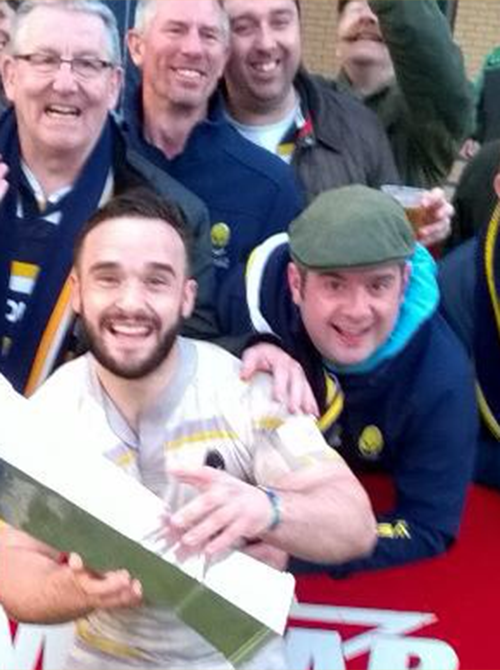
The players embraced, the coaches celebrated and the supporters had their moment. Worcester Warriors, a club that had been absent from professional rugby for almost three years, were Championship winners in their first season back.
The significance of the achievement cannot be measured simply by the final score. It was the culmination of a rebuilding effort that had required a new ownership structure, a coaching team, a squad assembled from scratch, a functioning professional operation and the commitment of a supporter base that had refused to abandon the club.
The final also brought the careers of Lloyd Williams and Matt Rogerson to a close. Williams had played the final professional match of his career, while Rogerson's retirement brought an end to his playing days. Their contribution to the season had been part of a collective effort, but the opportunity to finish with a Championship medal gave the occasion an added poignancy.
The club's chairman, Chris Holland, described the victory as a moment of immense pride in his end-of-season statement on 1 June. He credited the players and coaching staff for their resilience and ambition, while also recognising the work of staff behind the scenes, including operations, finance, media, administration, commercial, hospitality and matchday teams. [9]
That acknowledgement was important. The title belonged to the players who had performed on the pitch, but the success had been made possible by the wider organisation. The rebuilding of Worcester Warriors was not simply a sporting project; it was the reconstruction of a professional club.
And the supporters had played their part. They had returned to Sixways, travelled to away grounds, supported the new squad and helped restore the atmosphere that makes Worcester Warriors more than a name on a fixture list.
The championship trophy was a tangible reward for all of that work. It was also a reminder of what had been lost in 2022 and what had been recovered by 2026. |
What the title means — and what it does not mean
It is important to be precise about the significance of Worcester's victory.
The Warriors won the 2025–26 Championship play-off final and were crowned champions of the competition. They did not, however, secure promotion to the Premiership.
On 27 February 2026, the Rugby Football Union approved a major restructuring of English professional rugby. From the 2026–27 season, automatic promotion and relegation between the Premiership and the Championship would be replaced by a criteria-based expansion and demotion model. The Premiership's stated ambition was to expand from ten clubs to twelve by 2029–30, with entry assessed against factors including sporting performance, financial sustainability, investment, infrastructure and geographical reach. [10]
The change meant that winning the Championship was no longer, by itself, a route to promotion. Worcester would need to establish a credible application for entry under the new system if it wished to return to the top division.
That is not a criticism of the title or an attempt to diminish the achievement. The Warriors won the competition in front of them, defeated the league's outstanding team in the semi-final and beat the second-placed side in the final. They earned their trophy on the field.
But the distinction matters because the title and the club's longer-term ambitions are separate questions. Winning the Championship demonstrated that Worcester could rebuild a competitive team and succeed in professional rugby. Returning to the Premiership will require the wider business, facilities and regulatory conditions to be met under the new system.
The club's recovery is therefore not complete. The commercial and events operation must continue to develop, Sixways must remain a viable home for professional rugby, and the longer-term redevelopment plans must be judged by their ability to support a sustainable club.
Those questions belong to the wider story of Worcester's future, which will be examined in Chapter 15.
For the moment, however, the title should be celebrated for what it was: a remarkable sporting achievement by a club that had fought its way back from the brink. |
The meaning of the journey
There are seasons that are remembered for the quality of the rugby, and there are seasons that acquire a deeper significance because of what came before them.
For Worcester Warriors, 2025–26 was both.
The players had to win matches, adapt to one another and overcome difficult opponents. The supporters had to rebuild their relationship with a club that had disappeared from the professional game. The coaches and management had to establish a new operation and create a team capable of competing in the Championship.
The title was the result of all those elements coming together.
It would be wrong to portray the season as flawless. Worcester lost eleven league matches, finished fourth rather than first, and had to fight hard in both play-off rounds. The club remained in the Championship, and the wider challenge of building a sustainable business continued.
But those facts make the achievement more impressive, not less. The Warriors were not an established side carrying a title challenge into the play-offs. They were a newly assembled team that grew in confidence, discovered its strengths and produced its best rugby when the stakes were highest.
The semi-final victory over Ealing was the defining statement of their competitive ability. The final against Bedford was the moment they turned that statement into silverware.
For the supporters, there was an additional meaning. The club had returned, and it had given them a season that belonged in the history of Worcester Warriors.
The chants that had echoed around Sixways during the difficult years could now accompany a trophy-winning team. The blue and gold were back in professional rugby, and the Warriors had shown that the name could still inspire performances worthy of the club's traditions.
The championship did not erase the financial collapse, restore the old corporate structure or resolve every question about the future of Sixways. It did not return Worcester to the Premiership.
What it did was restore pride, belief and momentum. And after everything that had happened, those were achievements worth celebrating. |
Back where we belong?
The title of this chapter carries a familiar sentiment, but it deserves a careful interpretation.
Worcester Warriors had returned to the professional game and won its second tier in their first season back. They had proved that the club could assemble a competitive squad, bring supporters back to Sixways and compete successfully against established Championship opposition.
In that sense, Worcester were back where they belonged: on the rugby map, competing for honours and giving their supporters something to believe in.
But the journey towards the Premiership remains a separate challenge. The new rules mean that sporting success alone will not determine entry to the top division. Worcester will need a sustainable business, appropriate facilities, a credible investment plan and the ability to satisfy the criteria established for future expansion.
The commercial and events work described in Chapter 13, together with the long-term Sixways proposals, will therefore be crucial to the club's ambitions. The trophy has demonstrated what the team can achieve. The next task is to ensure that the organisation supporting it is strong enough to sustain that success.
There is no guarantee of a return to the Premiership, and it would be wrong to suggest otherwise. But Worcester Warriors have already demonstrated something important: the club can recover from a collapse, rebuild a team and win a championship.
That is a foundation on which to build.
For now, the supporters can look back on the final at Bedford with pride. The players who arrived in the summer of 2025 had become a team, and the team had become champions. A club that had been absent from professional rugby had returned to win a trophy in its first season back.
The road from administration to Bedford was long, uncertain and demanding. It was travelled by the people who rebuilt the club, the players who wore the shirt, the staff who worked behind the scenes and the supporters who never stopped believing that Worcester Warriors deserved another chance.
On 31 May 2026, that belief was rewarded.
Worcester Warriors were Championship winners.
The blue and gold had their trophy.
And the next chapter of the club's history could
begin with pride rather than uncertainty. |
Sources and evidence
[1] BBC Sport — Worcester Warriors Championship table, 2025–26. Regular-season position, results, points and points difference; confirms Ealing's 26 wins and Worcester's fourth-place finish.
https://www.bbc.co.uk/sport/rugby-union/teams/worcester/table
[2] Worcester Warriors — “Warriors Fall to Defeat at Bedford”, 21 December 2025; “Warriors Suffer Defeat Against Bedford”, 12 April 2026. Reports of the two regular-season defeats to Bedford.
https://warriors.co.uk/news/warriors-fall-to-defeat-at-bedford/
https://warriors.co.uk/news/warriors-suffer-defeat-against-bedford/
[3] BBC Sport — Worcester Warriors v Chinnor, Championship quarter-final, 16 May 2026. Match score, scoring timeline and line-ups.
https://www.bbc.co.uk/sport/rugby-union/match/EVP5568437
[4] BBC Sport — Ealing Trailfinders v Worcester Warriors, Championship semi-final, 23 May 2026. Final score, scoring timeline and line-ups; confirms Worcester's 34–29 victory.
https://www.bbc.co.uk/sport/rugby-union/match/EVP5630438
[5] Bedford Blues — “Magnificent Blues Set Up Home Final”, 22 May 2026. Bedford's 58–24 semi-final victory over Coventry and confirmation of the final venue.
https://bedfordrugby.co.uk/news/2026/05/report-magnificent-blues-set-home-final
[6] Worcester Warriors — Retirement announcements for Lloyd Williams and Matt Rogerson, May 2026.Confirms their decisions to retire at the end of the season.
https://warriors.co.uk/news?page=5
[7] Worcester Warriors — “A Letter from Evs…”, 30 May 2026. Matt Everard's reflections on the club's collapse, return, the supporters and the final.
https://warriors.co.uk/news/a-letter-from-evs/
[8] BBC Sport — “Worcester Beat Bedford in Champ Play-off Final”, 31 May 2026; Bedford Blues — “Heartbreak in Champ Final”, 31 May 2026. Final score of 27–14, match narrative and scoring details.
https://www.bbc.co.uk/sport/rugby-union/articles/c4g0501rle9o
https://bedfordrugby.co.uk/news/2026/05/report-heartbreak-champ-final
[9] Worcester Warriors — “Chairman's End of Season Statement 2026”, 1 June 2026. Chairman Chris Holland's comments on the title, players, coaches and behind-the-scenes staff.
https://www.warriors.co.uk/news/chairmans-end-of-season-statement-2026/
[10] BBC Sport — “Prem Relegation Scrapped from 2026–27 Season”, 27 February 2026; Rugby Football Union and professional-game stakeholders' reform announcement. Explains the move away from automatic promotion and relegation and the criteria-based expansion model.
https://www.bbc.co.uk/sport/rugby-union/articles/cg4g3xrxv6po
https://www.thepwr.com/news/rugby-unites-behind-transformational-new-vision |
WHAT DO YOU THINK ABOUT THE ARTICLE
(Make your selection below) |
|
|
|
|
|
 |