 |
CHAPTER 4
FOLLOWING THE MONEY
There is a moment in every financial investigation when the figures stop being abstract.
They become a trail.
A payment arrives. A company receives it. Another company owes money to the first. A loan appears. A balance is waived. An accounting profit suddenly emerges. Assets are revalued. Debts are transferred. And somewhere in the middle of it all, millions of pounds have changed hands.
For Worcester Warriors, that trail is particularly important because one of the most significant injections of money into the club came in March 2019, when CVC Capital Partners made a payment of £12,532,434.76 to WRFC Trading Ltd.[1]
What happened to that money?
The administrators' later report provides one important answer. It states that a large proportion of the CVC funds was used to pay what it called "windfall agreements".[1]
But that is where the certainty ends.
The administrators did not, in the public report we have located, identify the individual recipients, the individual amounts or the precise contractual nature of those agreements.
That omission matters.
Because the £12.5 million payment was not a minor event in the history of Worcester Warriors. It arrived at a club which had already been operating with substantial losses and significant liabilities, and it arrived only months after the change of ownership.
To understand what happened next, we therefore have to follow the money through the accounts, the companies and the transactions that can actually be established. |
THE £12.5 MILLION ARRIVES
On 29 March 2019, WRFC Trading received £12,532,434.76 from CVC Capital Partners.[1]
CVC had invested heavily in Premiership Rugby and, following that investment, made payments to the individual Premiership clubs.
For Worcester, the payment was transformational in scale. But it did not arrive into an empty balance sheet.
The club had already experienced substantial losses. The 2016–17 accounts recorded a pre-tax loss of approximately £8.1 million, while the financial structure inherited by the new owners contained substantial liabilities.
The CVC money therefore arrived into an organisation with existing financial pressures. And, according to the administrators, a large proportion was subsequently committed to the "windfall agreements".[1]
That phrase is one of the most intriguing — and least explained — phrases in the entire financial story of Worcester Warriors.
We know the phrase was used.
We know it related to the CVC funds.
But the public documents we have located do not tell us who received the payments, how much each person or organisation received, or precisely what contractual obligations the payments discharged.
It would be wrong to fill that gap with speculation. So the question remains open.
Who received the windfall agreements, and how much did they receive? |
THE £11.6 MILLION QUESTION
The 2019 WRFC Trading accounts introduce another enormous figure.
For the year ended 30 June 2019, the company recorded:
£15,759,336 of administrative expenses.
But, separately, it recorded:
£11,605,149 of exceptional administrative expenses.[2]
That is an extraordinary number.
And because it appears in the same financial year as the £12.532 million CVC payment, it is naturally tempting to connect the two. But that would be going beyond the evidence.
The accounts, as reproduced in the administrators' material, establish the existence of the £11.605 million exceptional expense. The administrators' narrative separately says that a large proportion of the CVC funds was used for windfall agreements.
What the public record we have located does not establish is that the £11.605 million exceptional expense was itself the windfall agreements.
Those are two separate facts. They may be connected. They may not.
Until the underlying accounting note or other documentary evidence establishes the composition of the £11.605 million, we cannot responsibly say.
That distinction is important because this investigation is intended to follow the evidence rather than manufacture an explanation for it. |
THE NUMBERS IN THE 2019 ACCOUNTS
The 2019 WRFC Trading accounts provide a remarkable picture.
Turnover was approximately £11.423 million.
Gross profit was approximately £10.810 million.
Administrative expenses were approximately £15.759 million.
Exceptional administrative expenses added another £11.605 million.
Yet the accounts also recorded approximately £7.381 million of other operating income or movements.
The result was an operating profit of approximately £14.036 million, followed by a profit before tax of approximately £13.664 million and a profit after tax of approximately £12.938 million.[2]
At first glance, those figures appear almost impossible to reconcile with the underlying financial difficulties of the rugby club. But there is a crucial accounting distinction.
The £7.381 million "other operating income/movements" should not simply be treated as another pile of cash.
The P Share investment was carried at a substantially higher value, and the accounting records reflect a major revaluation movement. That is an accounting entry, not equivalent to £7.381 million arriving in the bank.
The distinction between cash received and accounting value is fundamental to understanding the Warriors' financial history.
A club can report a substantial accounting profit while having very little additional cash available.
And that distinction becomes increasingly important as the story develops. |
THE MONEY THAT WAS ALREADY THERE
There is another financial trail which predates the CVC payment.
Worcester Sport Ltd, the parent company then known as Militibus Quanco, produced accounts for the year ending 28 February 2019.
Those accounts recorded approximately £7.595 million owed to group undertakings.[3]
The significance of the date should not be overlooked.
The accounts closed on 28 February 2019.
The CVC payment did not arrive until 29 March 2019.
Therefore, the £7.595 million group balance cannot simply be described as the CVC money.
Something financially significant already existed between the companies before the CVC funds arrived.
That is an important finding because it changes the question. The financial story did not begin with the CVC payment.
There was already a substantial inter-company relationship within the corporate structure.
The precise origin and movement of that balance therefore form a separate part of the investigation. |
THEN THE INTER-COMPANY BALANCE CHANGES
By February 2020, Worcester Sport's accounts showed only approximately £300 owed to group undertakings, compared with approximately £7.595 million a year earlier.[3]
During that same financial year Worcester Sport reported a profit of approximately:
£11.882 million.[3]
Its net liabilities fell from approximately £12.497 million to £614,000.
Those numbers are striking.
But again, they must be treated as accounting figures rather than evidence that £11.882 million in cash suddenly arrived.
The crucial question is what produced the accounting profit.
And here the later regulatory record becomes important. |
THE AUDITOR'S WARNING
AFTER THE EVENT
In March 2026, the Institute of Chartered Accountants in England and Wales disciplined the former auditors of the Warriors companies, Bishop Fleming.
The firm received a severe reprimand, a fine of £124,250 and was ordered to pay costs of £26,885.[4]
The disciplinary decision identified four separate areas of failure.
One concerned the disclosure of a loan transaction.
Another concerned the going-concern assessment in WRFC Trading's 2020 accounts.
A third concerned a transaction in the 2019 accounts.
And perhaps most importantly for this investigation, the decision found that the auditors had failed to obtain sufficient appropriate audit evidence concerning credits arising from the waiver of inter-company balances in Worcester Sport's 2020 accounts.[4]
That finding does not establish wrongdoing by the Warriors' directors or owners.
It does not establish that the waiver was improper.
But it does establish something important:
the inter-company waiver was sufficiently significant to form part of a subsequent professional disciplinary finding against the auditors.
That makes the transaction impossible to ignore. |
THE £11.882 MILLION PROFIT
The Worcester Sport accounts subsequently showed the £11.882 million profit.
The accounts also showed the dramatic improvement in net liabilities.
The later ICAEW finding tells us that credits arose from the waiver of inter-company balances.
What we still do not have from the public documents located for this investigation is a complete transaction-by-transaction reconciliation showing:
-
the original amount of the inter-company balance;
-
precisely which company was the creditor;
-
when the underlying loan or balance was created;
-
the purpose of the original transaction;
-
precisely how much was subsequently waived;
-
the accounting entries used to record the waiver;
-
and how the remaining elements of Worcester Sport's £11.882 million profit were generated.
That is not a criticism of the accounts themselves.
It is a statement of the limit of the evidence currently available to us.
And that distinction matters. |
THE WINDFALL QUESTION
There is another issue which refuses to disappear.
The administrators stated that a large proportion of the CVC funds was used to pay
"windfall agreements".[1]
Shortly afterwards, the relationship between the parties involved in the ownership structure became untenable.
Colin Goldring and Jason Whittingham subsequently purchased the interests of Gerard McCrory and Michael Blood, with McCrory and Blood resigning as directors of WRFC Trading on 11 June 2019.[1]
The chronology is therefore clear:
29 March 2019
£12.532 million CVC payment.
Following that payment
Administrators later say a large proportion was used for "windfall agreements".
11 June 2019
McCrory and Blood resign as directors following the change in ownership interests.[1]
But chronology is not causation.
The public evidence located for this investigation does not establish that the windfall agreements were payments to McCrory, Blood, Goldring, Whittingham or any other named individual.
Nor does it establish that the payments caused the subsequent ownership change.
Those would be allegations, not established facts.
So we will not make them.
The responsible conclusion is simpler:
The administrators identified the windfall agreements as a significant use of the CVC funds, but the public record we have located does not disclose their full financial details.
That remains an unanswered question. |
WHAT ABOUT THE £7.381 MILLION?
The 2019 accounts also contain the £7.381 million accounting movement.
It is important that this figure is not confused with the CVC payment.
The P Share had become an increasingly valuable asset in the Warriors' balance sheet, and the accounts reflected a substantial revaluation. The P Share was not simply cash sitting in a bank account.
Its value became enormously important later, when the government-backed COVID loan was secured against the club's assets and the P Share became one of the principal assets available to creditors.
This is one of the recurring themes of the Warriors' financial history:
an asset can have a substantial balance-sheet value without producing equivalent cash.
The P Share would eventually become central to the club's survival attempts
and ultimately to the administration. |
THE FUNDING PROBLEM
WAS NOT CREATED BY COVID
The financial evidence also makes one thing clear.
COVID dramatically worsened the Warriors' position, but it did not create every financial problem from nothing. Before the pandemic, the club was already seeking significant additional funding.
The administrators later reported that T3 Capital had offered a £15 million loan, but the offer was withdrawn following the outbreak of COVID-19.[1]
That is important context.
The club was already seeking substantial new finance before COVID transformed the economics of professional rugby.
COVID then arrived at precisely the wrong moment.
Matchday income disappeared.
The club's ability to generate normal revenue was severely restricted.
And the requirement for additional funding became more urgent.
The government-backed support which followed was enormous.
But it was borrowing. It was not free money. |
THE £15.7 MILLION GOVERNMENT LOAN
The administrators subsequently reported government/DCMS-backed funding with total principal advances of approximately:
£15.706 million
plus approximately:
£428,720 of interest.
The secured claim therefore stood at approximately:
£16.135 million.[1]
The security included major Warriors assets, including the P Share and property interests.
The administrators' statement of affairs later recorded the P Share and fixed-interest stocks at a book value of approximately £13.865 million, against the secured claim of more than £16 million.[1]
The government's intervention therefore bought time. But it also created another major secured debt. The money kept the club alive.
It did not solve the underlying structural problem. |
THE LAST STRETCH
By the summer of 2022 the financial position had become desperate.
The Guardian subsequently reported that the owners had raised £600,000 through a three-month loan carrying 20% interest, secured against the stadium car park.[5]
That loan was intended to help meet payroll.
A separate creditor was prepared to provide an alternative £780,000 interest-free facility if a buyer could be found and the existing charge released, but that alternative was not ultimately used.[5]
Whatever the arguments surrounding the ownership and the decisions made during those final months, the financial picture was now stark.
A club that had received:
-
millions from CVC;
-
substantial private investment;
-
a £15 million proposed T3 facility;
-
and more than £15 million of government-backed borrowing,
was now struggling to finance its immediate payroll.
That is the point at which the story moves from accounting history into crisis. |
WHAT WE KNOW
The evidence allows us to say the following with confidence.
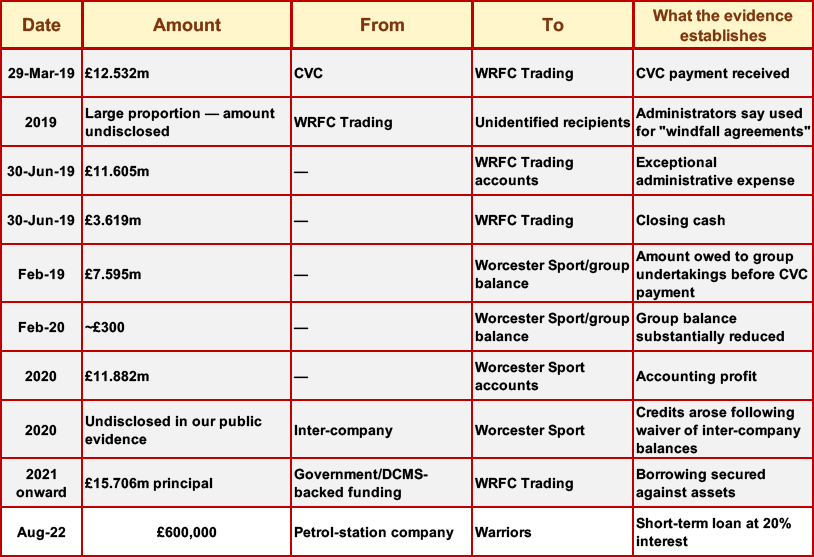
£12,532,434.76 was received by WRFC Trading from CVC on 29 March 2019.[1]
The administrators subsequently stated that a large proportion of the funds was used for "windfall agreements".[1]
The 2019 WRFC Trading accounts recorded £11.605 million of exceptional administrative expenses.[2]
The accounts also recorded approximately £7.381 million of other operating income/movements, associated with accounting movements rather than simply representing cash received.[2]
Worcester Sport already had approximately £7.595 million owed to group undertakings before the CVC payment arrived.[3]
That balance subsequently reduced to approximately £300.[3]
Worcester Sport recorded an £11.882 million profit for the year to February 2020.[3]
The later ICAEW disciplinary decision confirms that the auditors failed to obtain sufficient appropriate evidence concerning credits arising from the waiver of inter-company balances.[4]
The same disciplinary decision found other audit failures concerning the Warriors' accounts, including a loan disclosure and the 2020 going-concern assessment.[4]
The club subsequently received approximately £15.706 million of government-backed borrowing, plus interest, secured against major assets.[1]
And by August 2022, the club was relying on a £600,000 short-term loan at 20% interest to help meet payroll.[5]
These are not theories.
They are the financial milestones established by the documentary record. |
WHAT WE DO NOT KNOW
And this is where the investigation must be equally honest.
We do not currently have a public documentary breakdown identifying every recipient of the "windfall agreements".
We do not have the individual amounts paid under those agreements.
We do not have sufficient evidence to say that the £11.605 million exceptional administrative expense was the same thing as the windfall agreements.
We do not yet have a complete public reconciliation of the inter-company balance between WRFC Trading and Worcester Sport.
We do not have sufficient evidence to say exactly how much of that balance was subsequently waived.
We do not have a complete public breakdown of the £11.882 million Worcester Sport profit.
And we do not have the administrators' complete underlying bank-account analysis showing every movement of the CVC funds.
Those are not gaps that should be filled with assumptions.
They are gaps in the publicly available evidence identified during this investigation. |
THE MOST IMPORTANT CONCLUSION
There is a temptation, when looking back at Worcester Warriors, to reduce the financial story to a single question:
Where did all the money go?
The evidence tells us that the question is more complicated.
Money came into the club.
Money was spent.
Money moved between companies.
Assets were revalued.
Loans were made.
Balances were subsequently waived.
New borrowing was secured against assets.
And enormous accounting profits appeared without necessarily representing equivalent amounts of cash.
The CVC payment was real.
The government borrowing was real.
The losses were real.
The debts were real.
The eventual financial collapse was real.
But the public record does not currently provide a complete transaction-by-transaction explanation of every significant movement between those events.
That is the uncomfortable truth.
And it is more powerful than speculation.
Because the administrators themselves investigated the use of the CVC funds, the inter-company balances, connected-party transactions and other financial movements.[1]
The auditors were subsequently disciplined over failures involving some of those transactions.[4]
Yet even after all of that, the public record available to us still does not answer every question. |
THE FINANCIAL SPINE
|
A WORD ABOUT THE £12.5 MILLION
Perhaps the most important thing this chapter establishes is not an answer.
It establishes the boundary between what is known and what is not known.
We know £12.532 million arrived.
We know the administrators subsequently said a large proportion was used for windfall agreements.
We know the accounts contain an £11.605 million exceptional expense.
We know substantial inter-company transactions existed.
We know an inter-company balance was subsequently waived.
We know the auditors were later disciplined over their handling of that waiver and other aspects of the Warriors' accounts.
But we cannot responsibly join those dots with a line that the evidence does not provide.
So, for now, the public record leaves us with a question rather than an accusation:
What exactly happened to the £12.532 million
that entered Worcester Warriors in March 2019?
The answer may exist in bank statements, agreements, working papers or documents that were never made public.
If it does, it has not yet emerged into the documentary record available to this investigation.
And that is where Chapter 4 ends.
Not with an allegation.
Not with a convenient theory.
But with a trail of millions of pounds, several identified transactions, a series of unanswered questions — and a financial story that was already becoming considerably more complicated than the rugby being played on the pitch.
The next chapter takes us into the years when COVID arrived, the doors of Sixways closed, and the financial pressure became a fight for survival. |
WHAT DO YOU THINK ABOUT THE ARTICLE
(Make your selection below) |
|
|
|
|
|
 |