 |
CHAPTER 5
COVID AND THE £15 MILLION QUESTION
The pandemic did not create every problem at Worcester Warriors. But it changed the scale of the crisis, transformed the club's borrowing and left a debt burden that would become central to its eventual collapse.
By the spring of 2020, Worcester Warriors were facing a financial challenge that few could have anticipated in its full extent. The world was entering an unprecedented public-health emergency, professional sport was about to be disrupted on a scale not seen in modern times, and the commercial activity that sustained rugby clubs across the country was suddenly under threat.
For Worcester, however, the timing could hardly have been worse. The club was already operating within a complicated financial structure, carrying substantial liabilities and seeking additional funding. The previous chapter examined the £12.532 million CVC payment received in March 2019, the exceptional expenses recorded in the accounts and the unresolved questions surrounding inter-company transactions. Those matters form the financial background to what followed, but the next stage of the story has its own distinct trail: the funding that was sought before COVID, the government money that arrived during the pandemic, the assets used to secure it, and the growing debt that remained when Sixways finally entered administration.
The distinction is important. COVID was a genuine and devastating financial shock. It would be wrong to minimise its impact or pretend that a rugby club could simply carry on trading normally when spectators were prohibited from attending matches and other events were cancelled. Equally, it would be wrong to present the pandemic as the beginning of all Worcester's financial difficulties. The evidence shows that the club was already seeking substantial additional finance before the crisis began.
The question is not whether COVID hurt Worcester Warriors. It unquestionably did. The question is how a club that needed major funding before the pandemic, and then received millions in emergency government support, reached the point where it could no longer continue. |
The £15 MILLION THAT NEVER ARRIVED
One of the most revealing passages in the administrators' account of Worcester Warriors' financial history concerns a proposed loan from T3 Capital.
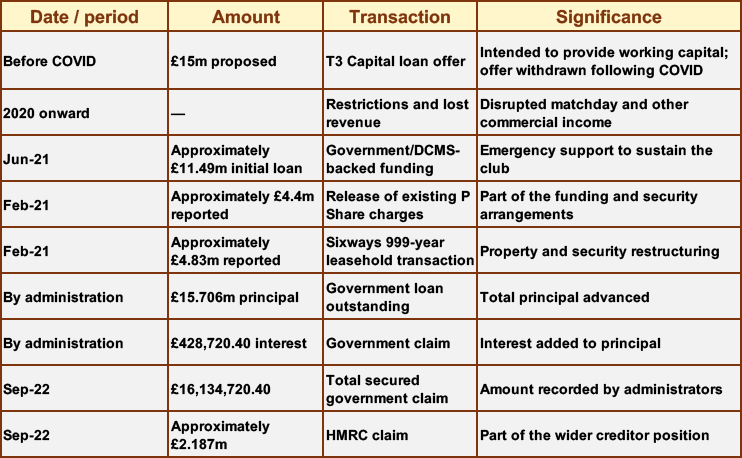
According to the administrators, the losses being incurred by WRFC Trading prompted the directors to seek additional funding. Discussions took place with T3 Capital, which offered a loan of £15 million. The administrators state that the proposed facility was intended to provide sufficient working capital to take the company to the point at which it could break even. The offer was subsequently withdrawn following the outbreak of COVID-19 and the associated disruption.[1]
The significance of that statement should not be lost. Before the pandemic had fully taken hold, the club was already looking for £15 million of additional finance. This was not a modest overdraft to cover a temporary gap between matchdays. It was a substantial proposed facility, intended to help the business reach a sustainable operating position.
The administrators' account provides the basis for an important question: what would have happened had the loan been completed? We cannot answer it. There is no reliable way of knowing whether the funding would have enabled Worcester to reach break-even, whether further finance would have been required or whether the underlying financial pressures would eventually have re-emerged. The administrators describe the intended purpose of the facility; they do not establish what the outcome would have been.
What we can say is that the proposed loan did not provide the club with the funding it was seeking. COVID arrived, the offer was withdrawn and Worcester lost a potential source of substantial working capital at precisely the moment when its need for cash was about to become more urgent.
That is the first major turning point in this chapter. |
WHEN THE TURNSTILES STOPPED TURNING
Professional rugby depends on more than the money paid for a ticket. At Sixways, matchdays supported hospitality, catering, bars, staffing and other commercial activities. The stadium also had potential and established uses beyond the first team, including events and functions. Together, these activities formed part of the business that had to be sustained whether or not the team was playing at home.
When the pandemic brought restrictions on gatherings and sporting events, those income streams were disrupted. The club could not rely on normal matchday receipts, while the cancellation of other events further reduced commercial activity. The costs and liabilities of operating the business did not automatically disappear simply because spectators could no longer attend.
The administrators later described the resulting cash-flow difficulties. Their account records the impact of government restrictions, the depletion of cash reserves and the company's inability to pay its debts as they fell due. They also recorded that the directors regarded COVID, the lockdowns and the economic changes that followed as the root cause of the company's eventual failure.[1]
That explanation deserves to be reported fairly. The pandemic placed extraordinary pressure on professional sport, and Worcester was not alone in suffering. But the directors' explanation is not, by itself, proof that COVID was the sole cause of the collapse. The club's pre-pandemic funding requirement, the financial structure inherited from earlier years and the decisions made during and after the pandemic must all be considered alongside the external shock.
The administrators also reported that a business-interruption insurance claim was rejected. No insurance payment was received.[1] That removed another possible source of support at a time when the club was struggling to replace lost income.
Worcester therefore faced a difficult combination: reduced revenue, continuing financial obligations, depleted cash reserves and the loss of the proposed T3 facility. Emergency support became essential if the club was to survive. |
THE GOVERNMENT'S SURVIVAL PACKAGE
The government recognised that the pandemic posed a serious threat to spectator-dependent sport. It introduced the Sport Winter Survival Package, administered by Sport England on behalf of the Department for Digital, Culture, Media and Sport (DCMS), to provide financial assistance to eligible sporting organisations affected by restrictions and the loss of normal income.[2]
Worcester Warriors received support through this scheme. The administrators' material records an initial government-backed loan of approximately £11.49 million, with the first funds advanced in June 2021. The loan was supported by security over the club's assets.[1]
This intervention gave Worcester a lifeline. It provided funding at a time when the club's normal revenue streams had been severely disrupted and alternative private finance was no longer available on the terms previously proposed.
But the nature of the intervention matters. This was borrowing, not a grant that could simply be treated as income with no repayment obligation. The money helped the club continue operating, but it also created a substantial liability. The government's position as lender, and the security it required, would become central to the story when the company entered administration.
The initial support was not the end of the borrowing. Further advances followed, taking the principal outstanding to approximately £15.706 million. By the time the administrators were appointed in September 2022, the interest recorded against the government's claim was approximately £428,720.40, bringing the total secured claim to £16,134,720.40.[1]
The scale of the intervention was considerable. So was the obligation it left behind. |
WHY SECURITY MATTERED
The government was lending public money to businesses operating under exceptional pressure. It therefore sought security to protect its position should a borrower fail to repay. For Worcester, that requirement brought the club's existing corporate and property arrangements into sharp focus.
As Chapter 3 explained, Sixways was not simply one asset owned outright by the rugby trading company. The freehold, long leasehold interests and rugby operation had been separated through a series of transactions following the 2018 takeover. The P Share in Premiership Rugby was another valuable asset, with a distinct legal and financial position.
That structure mattered because the government needed enforceable security over assets. The funding arrangements consequently involved not only the provision of working capital but also transactions affecting existing charges and the legal interests surrounding the stadium and the P Share.
The existence of those transactions does not, on its own, establish that they were improper. Their significance lies in how they changed the security structure and in what they reveal about the relationship between the rugby business, its assets and its creditors.
Two transactions in February 2021 are particularly important. |
THE P SHARE: RELEASING THE EXISTING CHARGES
The P Share was one of Worcester Warriors' most valuable assets. It represented the club's interest in Premiership Rugby and had become increasingly important to the club's financial position. But its value was not the same as cash available to pay wages, suppliers or tax bills, and it had already been subject to security arrangements.
The Guardian's investigation into Worcester's collapse reported that, in February 2021, approximately £4.4 million was used to release existing charges over the P Share as part of the wider government-backed funding and security arrangements.[3]
This is a crucial distinction. Releasing an existing charge does not create new money for the rugby operation. It changes the legal position of the asset and the creditor who has security over it. The transaction formed part of the arrangements through which the government sought to protect its loan.
The P Share would later become central to the administration because it was one of the assets against which the government had secured its claim. At the time, however, the immediate purpose of the transaction was to deal with existing security as part of the new funding structure.
The important point is not that the P Share was involved in a transaction. It is that an asset whose value was vital to the club's financial standing was also part of the security arrangements underpinning its survival. |
SIXWAYS AND THE £4.83 MILLION TRANSACTION
The stadium property was the other major part of the story.
The post-2018 property structure separated different interests in Sixways, including the freehold and the long leasehold interests. This meant that any transaction involving the site had to be understood in the context of those separate legal rights and the companies holding them.
The Guardian reported that approximately £4.83 million was used in February 2021 in connection with the acquisition of the 999-year leasehold interest in Sixways.[3] The transaction was part of the wider arrangements surrounding the government funding and the security required for it.
The property position remained complex. MQ Property's subsequent accounts described Sixways as having been brought back under MQ Property's ownership. The distinction between the property company and the rugby trading company therefore remained important: ownership or control of the land did not automatically mean that the rugby operator owned every interest in it.
The £4.83 million transaction should not be described as though the rugby club simply spent that amount on its ordinary running costs. It concerned the stadium's property interests and formed part of a wider financial and security structure. Nor should the transaction, simply because it involved a valuable asset and public-backed borrowing, be characterised as wrongdoing without further evidence.
Taken alongside the reported £4.4 million relating to the P Share charges, the two figures amount to approximately £9.23 million. That illustrates how much of the financial restructuring concerned assets, property rights and existing security rather than representing unrestricted new money for the rugby operation.
However, the two transactions must be treated carefully. The public material establishes the reported amounts and their broad purpose, but a complete cash-flow reconciliation would be required to show precisely how each advance was allocated and how the transactions were recorded across the different companies.
The central lesson is clear: the headline value of the government loan does not tell us how much was freely available to fund day-to-day rugby operations. |
A LIFELINE WITH A PRICE
By the end of the funding process, Worcester had received substantial government-backed assistance. Without it, the club might have been unable to continue through the pandemic. But the money had to be repaid, and the government's security gave it a different position from that of an ordinary supplier.
The administrators' statement of affairs recorded the government's secured claim at £16.135 million. It also recorded the P Share and fixed-interest stocks at a book value of approximately £13.865 million.[1] The latter figure was an accounting value, not a guarantee of what the assets would realise in an insolvency.
Those numbers provide a warning, but they must not be compared as though they were a complete valuation of all assets available to the government. The ultimate recovery depended on the security held, the assets covered, their realisable values and the costs and legal priorities involved in the administration.
What the figures do establish is that the government's claim had become enormous. The funding had helped Worcester survive the immediate emergency, but the resulting debt was now one of the dominant features of the club's balance sheet.
The club had bought time.
It had not removed its liabilities. |
THE TAX BILL AND THE OTHER CREDITORS
The government loan was only one part of Worcester's financial obligations. The administrators' statement of affairs recorded a claim by HMRC of approximately £2.187 million against WRFC Trading at the date of administration.[1]
The company also owed money to trade creditors, banks and financial institutions, and directors or connected entities. Season-ticket holders and other customers were among those affected by the collapse. These claims would have to be considered within the legal framework of the administration, taking account of the nature of each debt and any applicable security or preferential status.
The figures recorded by the administrators in September 2022 show how far beyond a single government loan the problem had grown. The secured government claim was substantial, but the company had other liabilities that could not be settled simply by pointing to the value of the P Share or the stadium.
This is an important distinction for the chapters that follow. A company's total liabilities do not all have the same legal status. A secured lender, a tax authority, a supplier, a player, an employee and a season-ticket holder may occupy different positions in the insolvency process. Their treatment and eventual recoveries must be established from the administrators' reports and final accounting, rather than assumed from the amount each was owed.
We will examine those creditor classes in detail in Chapter 9, and the realisation of the assets and the government's recovery in Chapter 10. |
THE SEARCH FOR FURTHER FUNDING
As the pandemic receded, the club still needed to operate a professional rugby business and meet its existing obligations. Government support had helped it through the immediate crisis, but the underlying financial challenge remained: Worcester had to generate enough cash to fund the team, maintain Sixways, pay suppliers and meet its tax and debt obligations.
The administrators later recorded discussions with Macquarie Group concerning a further cash-flow facility. According to their account, credit approval was obtained and the facility appeared close to completion, but it did not ultimately provide the solution the club needed.[1]
By July 2022, the company was also experiencing serious supplier arrears. A creditor issued a winding-up petition, which was subsequently withdrawn after the company paid that creditor in full.[1]
These events do not, by themselves, explain every decision made by the directors or establish the reasons why potential funding arrangements failed. They do, however, show that the club's need for liquidity had not disappeared after the government intervention.
The search for further funding is one of the key links between the pandemic years and the final summer of 2022. A club that had received millions in government-backed borrowing was still looking for additional cash-flow support and facing pressure from creditors.
That is the point at which the story moves from the emergency response to COVID towards the final crisis. |
WHAT THE PANDEMIC DID
AND DID NOT — EXPLAIN
The evidence supports a balanced conclusion.
COVID caused extraordinary disruption to Worcester Warriors. Normal matchday and event revenues were interrupted; cash reserves were depleted; the business-interruption insurance claim was rejected; and the club needed emergency government assistance to continue operating.
But the proposed T3 facility shows that substantial additional funding was being sought before the pandemic. The government loan then replaced neither all lost income nor all the club's existing financial pressures. It provided funding under terms that created a large secured debt, while the club continued to face tax liabilities, supplier arrears and the need for further working capital.
The most defensible conclusion is therefore this:
Worcester Warriors entered the pandemic with an existing funding problem. COVID transformed that problem into a much larger liquidity and debt crisis.
That does not settle every question about the decisions taken by the owners or the use of the money. Nor does it excuse or prove any particular decision. It places the pandemic in its proper financial context.
The £15 million T3 proposal was never completed. The government loan helped keep the club alive, but the principal outstanding eventually reached £15.706 million, with interest taking the claim to more than £16.1 million. The P Share and Sixways property interests became part of the wider security arrangements. And as the club moved into 2022, it still needed further finance. |
THE LIFELINE BECOMES A DEBT
By the summer of 2022, Worcester had survived the pandemic but had not escaped its financial consequences. The government-backed loan remained a major liability. Other creditors were owed money. The business continued to require cash, and attempts to secure additional funding had not resolved the position.
This is the central irony of the COVID years. The public intervention gave the club a chance to survive an exceptional crisis. Yet the funding came in the form of a secured loan, not a permanent injection of equity. It preserved the possibility of recovery, but it did not guarantee it.
The question was no longer simply whether Worcester Warriors could get through the pandemic. It was whether the club could generate enough sustainable income to operate, meet its liabilities and service the debt accumulated during the crisis.
The events of the final summer would show just how precarious the position had become.
The next chapter examines those warning signs: the mounting arrears, the attempts to find emergency finance, the search for a buyer and the final weeks before Worcester Warriors entered administration. |
WHAT WE KNOW
The administrators state that the club sought a £15 million loan from T3 Capital before COVID, with the facility intended to provide working capital to help the company reach break-even. The offer was withdrawn following the pandemic.[1]
The administrators describe the impact of COVID restrictions, the loss of normal business activity, depleted cash reserves and the unsuccessful business-interruption insurance claim.[1]
The club received an initial government-backed loan of approximately £11.49 million, with further advances taking principal borrowing to approximately £15.706 million. The government claim, including interest, stood at £16,134,720.40 at administration.[1]
The government loan was secured against club assets. The Guardian reported transactions involving approximately £4.4 million to release existing charges over the P Share and approximately £4.83 million in connection with the 999-year Sixways leasehold interest.[3]
The administrators recorded an HMRC claim of approximately £2.187 million and reported later discussions about further cash-flow finance, together with supplier arrears and a winding-up petition that was withdrawn after the creditor was paid.[1] |
WHAT WE DO NOT KNOW
The evidence does not establish whether the proposed T3 loan would have saved Worcester Warriors, or whether the business would have required further finance even if the loan had been completed.
The figures for the P Share and Sixways transactions do not, by themselves, provide a complete reconciliation of every pound of government funding. Establishing the exact cash flows and accounting treatment across the relevant companies would require the underlying transaction records and full accounting notes.
Nor does the fact that property and security transactions took place establish that they were improper. Their legal and financial significance must be considered in the context of the corporate structure and the terms of the government loan.
Finally, COVID should not be presented as either the sole cause of the collapse or an irrelevant excuse. The documented pre-pandemic funding requirement and the extraordinary impact of the pandemic both form part of the explanation. |
FINANCIAL SPINE
|
SOURCES & EVIDENCE
[1] Begbies Traynor, Joint Administrators' Statement of Proposals — WRFC Trading Limited. The administrators' account is the principal source for the T3 proposal, COVID-related difficulties, government borrowing, security, Macquarie discussions and the position at administration.
[2] UK Parliament, Hansard, statement concerning the Government's Sport Winter Survival Package and its administration by Sport England on behalf of DCMS.
[3] The Guardian, investigation into the financial collapse of Worcester Warriors, including the reported February 2021 transactions involving the P Share charges and the Sixways 999-year leasehold interest.
[4] National Audit Office, DCMS's Management of Its COVID-19 Loan Book, which discusses the government loan to Worcester Warriors and the subsequent insolvency recovery. |
EDITORIAL STANDARD
This chapter distinguishes between funding proposals, loans actually advanced, accounting liabilities, property transactions and cash available for day-to-day rugby operations. It does not infer wrongdoing from the existence of a transaction, and it distinguishes the administrators' account of events from independent conclusions. Where the public evidence does not establish a complete answer, the question remains open. |
WHAT DO YOU THINK ABOUT THE ARTICLE
(Make your selection below) |
|
|
|
|
|
 |