 |
CHAPTER 9
INSIDE THE ADMINISTRATION
The creditors, the claims and the money that had to be accounted for
When the administrators arrived at Sixways, they inherited far more than a rugby club in financial difficulty. They inherited a maze of companies, loans, property interests, unpaid bills and competing claims on whatever money could be recovered.
The scale of the collapse
On 27 September 2022, Julie Palmer, Andrew Hook and Julian Pitts of Begbies Traynor took control of the administration of WRFC Trading Limited. Their immediate task was to establish what the company owned, what it owed, which assets could be realised and whether anything could be recovered for creditors.
The first detailed picture emerged in November, when the administrators issued their Statement of Proposals. The figures were sobering. The government-backed COVID loan alone represented a claim of more than £16.1 million. HM Revenue and Customs was owed more than £2.18 million in unpaid VAT. Trade creditors were owed almost £2.86 million, while directors and connected entities appeared in the list of unsecured creditors with claims totalling £2.086 million.
There were also banks and financial institutions, season-ticket holders, customers who had paid deposits, and supporters who had bought tickets for matches that would never take place.
The BBC reported the overall Worcester Warriors debt position as exceeding £30 million. That headline figure needs context: it drew attention to liabilities across the troubled club structure, including the separate WRFC Players Limited insolvency. It should not be treated as though every pound was a debt of WRFC Trading Limited alone. The companies had different legal identities, and their creditor claims must be examined separately. [1]
The administrators’ own figures for WRFC Trading are the best starting point. They were not a final account of every recovery or an adjudication that every claim was valid. They were a statement of the position as understood at the beginning of the administration, with several important matters still under investigation. |
Who was owed money?
The administrators’ Statement of Affairs, dated 27 September 2022, gave a stark picture of the liabilities of WRFC Trading. 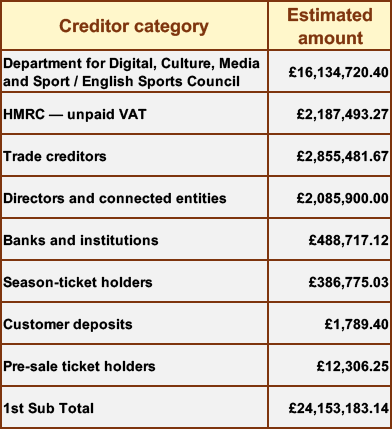
The figures above are taken from the administrators’ published report. They are not a complete statement of all liabilities across every Warriors-related company, and the connected-party amount was expressly subject to potential dispute. [2]
The government loan was the largest individual claim. At the date of administration, the principal stood at £15.706 million, with £428,720.40 in interest, producing a total claim of £16,134,720.40 before enforcement and other recoverable costs. The loan was secured through charges over the P Share and other assets. It therefore occupied a very different position from that of an ordinary supplier who had delivered goods or services and was waiting to be paid.
That distinction is fundamental to the story. Insolvency law does not simply divide whatever money is left among everyone who is owed something. Security, preferential status, the assets available and the costs of the insolvency process all affect who can recover money and in what order.
For Worcester’s smaller businesses, the position was particularly harsh. The administrators estimated that the company had insufficient assets available to pay a dividend to its unsecured creditors. That meant local suppliers and businesses could face losing money they had earned by working for the club. Supporters holding season tickets or advance tickets also appeared among the unsecured claims.
The figures are estimates made at the beginning of the process, and subsequent asset sales and payments altered the position of some creditors. But the underlying problem was clear: the liabilities substantially exceeded the assets expected to be available to meet them. |
The former owners: creditors as well as directors
One of the most striking findings was that Colin Goldring and Jason Whittingham, the men who had controlled Worcester Warriors in its final Premiership years, were also connected to companies claiming money from the club.
The administrators listed £2,085,900 under “Directors / Connected Entities”. The BBC reported that two companies associated with the former owners claimed to be owed more than £2 million by WRFC Trading. The administrators cautioned that the amount could be disputed. [1]
This is a crucial distinction. The claim did not establish that Goldring and Whittingham personally were each owed a particular sum, nor did it prove that the whole amount was accepted as a valid debt. The published figure related to directors and connected entities. To establish precisely who was claiming what, we must follow the individual companies, their accounts, the inter-company loan balances and the evidence supporting each claim.
The question is not merely whether money was owed. It is how the balances arose, whether the relevant transactions were properly recorded, whether they were repayable, and what the administrators ultimately accepted or challenged.
A former owner can be a creditor of a company without still owning it. Equally, a company associated with a former owner can hold a claim without that person personally being entitled to receive the money. Ownership, directorship, lending and creditor status are separate legal relationships.
For that reason, we should not describe the £2.086 million as money that Goldring and Whittingham had definitely lent to the club, or as money they were certain to recover. The administrators’ report did not establish either conclusion.
The claim nevertheless raises an important question for the wider investigation: how did the companies’ inter-company balances develop, and what did the underlying transactions represent? |
The £612,329 debt in the opposite direction
The administrators also identified a connected company that, according to WRFC Trading’s records, owed the rugby company £612,329.36.
This was not a creditor claiming money from Worcester. It was a potential asset of WRFC Trading: money that might be recoverable for the benefit of its creditors.
The directors told the administrators that the connected company was itself a creditor of WRFC Trading for a greater amount. In other words, the two sides of the relationship might involve competing claims. The administrators said that the matter remained under investigation and described the estimated realisation value of the £612,329.36 as uncertain. [2]
This is one of the reasons a company-by-company investigation is essential. If Company A owes Company B £600,000, but Company B also owes Company A a larger amount, the net position cannot be determined simply by looking at one line in one set of accounts. The underlying transactions, contractual terms, dates and any rights of set-off must be established.
The same issue arises throughout a group of connected companies. Money can move between entities for legitimate commercial reasons, but each transfer needs to be understood in its own right. A balance in an account is evidence of what the records say; it is not, by itself, a complete explanation of why the balance exists. |
The £36,862 paid into another company’s bank account
The administrators recorded another matter requiring investigation.
They had been advised that, in August 2022, after WRFC Trading’s bank accounts had been frozen following HMRC’s winding-up petition, the directors requested that debtors pay £36,862.25 into a connected company’s bank account instead. The administrators explicitly stated that this matter remained under investigation. [2]
That is what the published report establishes. It does not, on its own, establish that the money was stolen, that it was permanently diverted, or that the arrangement was unlawful.
The questions for the investigation are straightforward: which debtors made the payments, which connected company received them, where the money subsequently went, whether WRFC Trading received the benefit, and how the transactions were ultimately accounted for.
The administrators said they were examining bank statements covering the six years before their appointment, including payments to and receipts from connected parties. They were also reviewing the company’s management accounts, property transactions and the conduct of its directors.
Those investigations matter because they offer a route from the headline numbers to the underlying evidence. Without the bank records and the administrators’ eventual findings, we should not draw conclusions that the published material does not support. |
The two £500,000 Duckworth loans
The Duckworth name appears in two distinct parts of the Warriors story. They must not be confused.
The first: the Duckworth Worcestershire Trust loan associated with the 2018 sale.
As established in the earlier chapters, the 2018 acquisition terms included an undertaking to pay a £500,000 loan owed to the Duckworth Worcestershire Trust. That undertaking formed part of the purchase arrangements for the club. The original lender named in the administrators’ account was the Trust, not Beatrice Duckworth personally. [3]
The existence of that undertaking does not, by itself, establish the date on which it was discharged, the company that ultimately paid it, or whether any dispute arose over its repayment. Those matters need to be traced through the relevant company accounts and transaction records.
The second: the loan reportedly made by Cecil Duckworth in January 2020.
In August 2022, reporting emerged that the late Cecil Duckworth had lent £500,000 to the club’s owners in January 2020. His widow, Beatrice, and the family sought clarification about repayment. In the House of Commons on 22 September 2022, Worcester MP Robin Walker referred to the family’s concerns and reported that the owners disputed whether the full amount was owed. Their position, as described in Parliament, was that half the money had been promised on a handshake to cover the cost of employing then head coach Alan Solomons. The family accepted that they would not contest that point, according to the parliamentary account. [4]
These are attributed statements, not a final legal determination of the debt. We need to establish the precise borrower, the documentary evidence, the terms agreed, any repayments and how the claim was treated after administration.
It would be misleading to combine the two loans into a single £1 million debt, or to assume that the Trust’s earlier loan and Cecil Duckworth’s later loan were owed by the same legal entity. Nor should we claim that the later loan remains unpaid today without checking the final position.
For supporters, the central issue is clear: what happened to each loan, and what documentary evidence establishes its eventual outcome? |
The £600,000 car-park loan
The loan secured against the stadium car park is another important piece of the financial puzzle.
As reported by The Guardian in October 2022, the club’s owners raised £600,000 through a three-month loan carrying 20% interest from a petrol-station company. The loan was secured against the stadium car park. The same report described an alternative offer of £780,000, interest-free, which would have covered the entire payroll and included a commitment to release the charge if a suitable buyer could be found who would keep rugby at Sixways. The owners retained the original arrangement. [5]
The company named in the registered charges was Triangle Estate & Petroleum Limited. But the relevant charge was registered against MQ Property Co Limited, the property company, rather than simply being an ordinary unsecured loan listed among WRFC Trading’s creditors. This is an important distinction because the borrower, the owner of the charged land and the company operating the rugby business were not necessarily the same legal entity.
The administrators’ November 2022 report subsequently recorded that Jim O’Toole’s consortium had paid in full approximately £634,000 owed by MQ Property to Triangle Estate & Petroleum Limited. [2] Companies House later recorded the two Triangle charges against MQ Property as satisfied on 17 September 2024. [6]
That gives us a documented outcome for the registered security: the charges were eventually marked as satisfied. It also shows that the amount paid was approximately £634,000, rather than the original £600,000 principal reported in the press.
What the records do not yet establish is a complete reconciliation of the original loan, accrued interest, any other charges included in the settlement and the precise source of the repayment funds. Nor does the satisfaction of the charge tell us everything about the wider ownership of the car park. Those questions belong in the next chapter, where we examine the land, the leases and the property companies in detail.
One point must be made absolutely clear: this £600,000 loan was not the same transaction as the £500,000 deposit paid by the Atlas consortium to secure exclusive negotiations with the administrators. One was a property-secured loan; the other was a deposit in the sale process. They served different purposes and must remain separate in our accounts. |
What happened to the money from Premiership Rugby?
The administrators were also examining the £12,532,434.76 received by WRFC Trading from CVC-related distributions on 29 March 2019.
Their Statement of Proposals said that a large proportion of these funds had been used to pay “windfall agreements”. The public report did not identify every recipient, the individual amounts or the complete contractual basis for those payments. [3]
That statement is important, but it must not be stretched beyond what it says. It does not prove that the money was improperly paid, nor does it establish that the entire sum was distributed to individuals. The administrators’ broader investigation included the use of funds, connected-party transactions and the company’s bank records.
The 2019 accounts also contained an exceptional administrative expense of £11.605 million and a large figure under other operating income or movements. Those accounting entries need to be read alongside the original notes and transaction records; they cannot simply be equated with the windfall agreements or treated as cash payments without supporting evidence.
This is a question that deserves a full answer, because the money arrived at a critical point in the ownership story. But the answer must come from the documents, not from a theory built around the timing. |
The government loan and the creditors’ hierarchy
The £16.134 million claim held by the English Sports Council, acting as programme manager for the government’s COVID support, was secured by charges granted in February 2021. At the date of administration, the P Share and fixed-interest stocks were recorded at a book value of £13.865 million, although their realisable value was uncertain. The leasehold property was recorded at £15.188 million, again with realisation uncertain. [2]
Those book values were not cash in the bank. They were accounting values attached to assets, and the amount actually recoverable depended on the legal interests held, the security over them, the terms of any sale and the costs of realisation.
The administrators’ initial Statement of Affairs estimated that assets available for preferential creditors amounted to £564,011.66. Against that stood the HMRC claim of £2,187,493.27. After accounting for the government’s secured claim and the estimated shortfall, the statement showed no assets available for unsecured creditors. The estimated deficiency after secured charges was £17.758 million. [2]
These figures explain why the administrators could not simply promise that suppliers, players, staff or supporters would be repaid. Even if the company had assets with substantial book values, those assets were subject to security and the recoveries were uncertain.
The P Share later sold for £9.8 million, and the administrators confirmed that the bulk of the proceeds went towards repaying part of the government loan. That later realisation changed the position of secured creditors, but it did not mean that all debts across the Warriors group were settled. The BBC reported in August 2023 that unsecured creditors, including players and local businesses, were not expected to receive full repayment from the available assets. [7] |
The separate tragedy of WRFC Players Limited
While WRFC Trading was in administration, WRFC Players Limited was wound up by a High Court order on 5 October 2022. It was the company that employed Worcester Warriors’ players and staff. The Official Receiver became its liquidator and was responsible for winding down its affairs, realising available assets, distributing funds to creditors and investigating the circumstances of its insolvency, including the conduct of current and former directors. [8]
The BBC reported that WRFC Players owed approximately £6.8 million when it was wound up. That liability must not be added casually to a figure for WRFC Trading without explaining that the two were separate companies and that their claims may have related to different obligations. The player company’s liquidation had its own creditors and its own legal process.
For the players and non-playing staff, the consequences were immediate. Employment contracts ended, outstanding wages became claims, and individuals had to seek new employment or pursue payments available through the statutory insolvency and redundancy systems.
The Official Receiver’s published guidance confirms that creditors of WRFC Players must register their claims in that liquidation. It does not, by itself, tell us the final dividend, the full amount accepted for each claim or whether the liquidation has now concluded. Those are matters to establish from the latest insolvency filings and reports.
The same principle applies to the other companies in the wider Warriors structure. A company may be in administration, liquidation, receivership or still active. It may have ceased trading without being dissolved. Its liabilities may be separate from those of WRFC Trading. The legal status of each company must be checked individually before we can say what remains and who is responsible. |
What did the administrators actually investigate?
The administrators did not limit themselves to collecting unpaid invoices and selling equipment. Their published report described a broader investigation into the company’s affairs.
They requested information from creditors and directors, examined transactions between the club and connected parties, liaised with former employees, obtained records from solicitors and auditors, carried out Land Registry searches, requested six years of bank statements and reviewed the company’s management accounts against its filed accounts.
They also said they were investigating:
-
the balances between connected companies and the club;
-
possible wrongful trading;
-
land and property transfers entered into before administration;
-
the use of funds passing through the company’s bank accounts;
-
possible preference payments and transactions at an undervalue;
-
the outstanding debtor balances and payments due from Premiership Rugby.
The administrators expressly stated that they were not asserting that any particular claim was valid at that stage. Their duty was to investigate the affairs of the company and determine whether there were grounds for recovery actions or other claims. They also explained that detailed findings might not be disclosed immediately if doing so could prejudice potential claims. [2]
This is the boundary between a proper investigation and speculation. The existence of an investigation is not proof of misconduct. The fact that an administrator examines a transaction does not mean the transaction was unlawful. Any allegation must be supported by the eventual findings, a court decision or other reliable evidence.
The public record therefore allows us to identify the questions investigated. It does not allow us to pretend that every question has already been answered. |
What we know — and what remains unanswered
By the end of 2022, the scale of the financial collapse was no longer in doubt. The government was owed more than £16 million by WRFC Trading. HMRC had a substantial VAT claim. Suppliers, banks, supporters and connected companies had claims of their own. The players’ employer had entered liquidation with its own liabilities. The administrators were examining inter-company balances, the use of money, property transfers and the conduct of directors.
We also know that the former owners’ connected companies claimed more than £2 million, that a connected company was recorded as owing WRFC Trading £612,329.36, and that £36,862.25 in debtor payments was reportedly directed to a connected company’s bank account while the club’s own account was frozen. Those matters were identified for investigation, not presented as settled findings of wrongdoing.
The Triangle Estate & Petroleum loan provides a more complete trail: a loan secured against property, a later payment of approximately £634,000 by the O’Toole consortium on behalf of MQ Property, and charges subsequently recorded as satisfied. The two Duckworth-related loans remain separate questions, each requiring its own documentary trail.
What we cannot responsibly say, without further evidence, is that all claims were accepted, all loans were repaid, every connected-party balance was resolved, or every creditor eventually received money. The administration report was a snapshot of a complex process, and subsequent sales and payments changed some positions. The latest available records for each company and insolvency must be checked before we publish any conclusion about its present status. |
The question that leads us to the land
There is a reason the creditors’ story cannot be separated from the property story. Some of the largest claims were secured against assets that were not held by the rugby operating company alone. The stadium freehold, the 999-year lease, the 175-year lease, the car park and the rugby operation occupied different places in the corporate and legal structure.
That arrangement affected which assets were available to which creditors, who could enforce a charge, and what a prospective buyer could actually acquire. It also helps explain why the sale of the rugby club did not automatically settle the future of Sixways Stadium and its surrounding land.
To understand the recovery process, we must now follow those assets individually: the titles, leases, charges, transactions and companies that held them. Only then can we establish what the administrators and receivers were able to sell, what changed hands, what remained outside the rugby company, and who ultimately acquired the interests that mattered.
In Chapter 10, we turn to the assets themselves
Sixways, the land, the leases, the car park
The £9.8 million P Share. |
Sources and evidence
[1] BBC Sport, 21 November 2022, Worcester Warriors: Relegated Premiership club’s debts amount to more than £30m.
https://www.bbc.co.uk/sport/rugby-union/63690352
[2] Begbies Traynor, WRFC Trading Limited — Joint Administrators’ Statement of Proposals, dated 18 November 2022. The published report includes the Statement of Affairs, estimated creditor claims, asset valuations and the administrators’ description of their investigations.
https://www.scribd.com/document/625817695/Joint-Administrators-Statement-of-Proposals-WRFC-Trading-Limited
[3] Begbies Traynor, WRFC Trading Limited — Joint Administrators’ Statement of Proposals, sections covering the 2018 acquisition, the Duckworth Worcestershire Trust loan and the CVC-related payment received on 29 March 2019.
[4] UK Parliament, House of Commons, 22 September 2022, Worcester Warriors Rugby Club.
https://hansard.parliament.uk/commons/2022-09-22/debates/4B8C3EC3-219B-4F2A-BCDD-B501884CFE50/WorcesterWarriorsRugbyClub
[5] The Guardian, 5 October 2022, Worcester Warriors: the inside story of a rugby club’s collapse.
https://www.theguardian.com/sport/2022/oct/05/worcester-warriors-the-inside-story-of-a-rugby-clubs-demise
[6] Companies House, MQ Property Co Limited, company number 11472994, charges register. The register records the Triangle Estate & Petroleum Limited charges as satisfied on 17 September 2024.
https://find-and-update.company-information.service.gov.uk/company/11472994/charges
[7] BBC Sport, 7 August 2023, Worcester Warriors: Atlas paid £2m for ex-Premiership club, confirm administrators.
https://www.bbc.co.uk/sport/rugby-union/66430181
[8] The Insolvency Service, 5 October 2022, WRFC Players Limited: information for creditors and interested parties.
https://www.gov.uk/government/news/wrfc-players-limited-information-for-creditors-and-interested-parties |
Editorial standard
This chapter reports documented figures, attributed statements and the administrators’ stated investigations. A creditor claim is not automatically an accepted debt; an accounting balance is not necessarily a cash transaction; a charge being satisfied does not by itself establish the full legal ownership position; and an investigation does not prove wrongdoing. Any conclusion about the final repayment of a loan, the acceptance of a creditor claim or the outcome of an insolvency must be supported by the relevant later records. |
WHAT DO YOU THINK ABOUT THE ARTICLE
(Make your selection below) |
|
|
|
|
|
 |